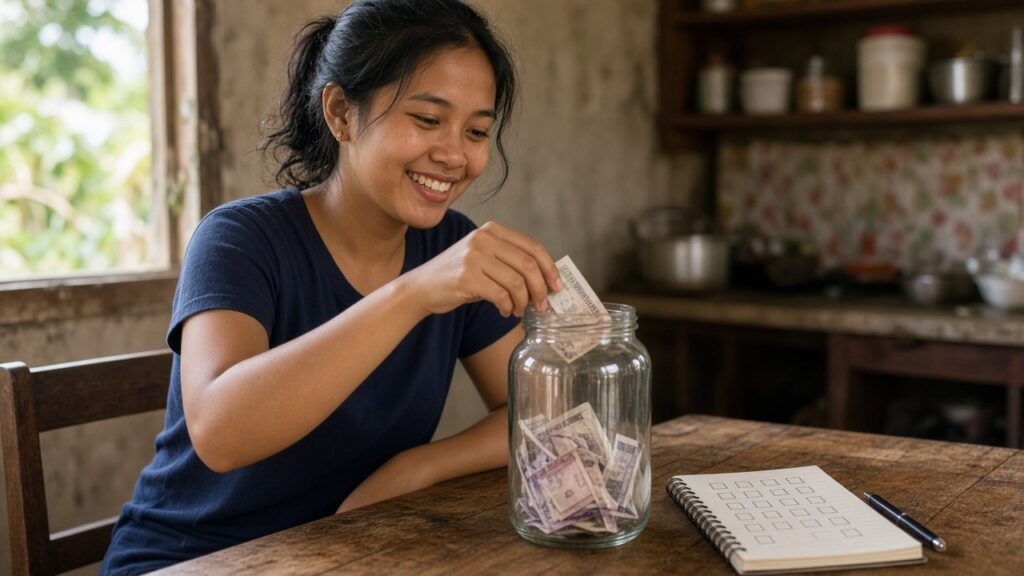
Saving money is easier when it feels like a game. That is the idea behind the 52-week money challenge, one of the most popular ipon challenges among Filipinos. You save a small, growing amount every week for one year, and by the end you have a lump sum you can use for Christmas, tuition, an emergency fund, or a goal you have been putting off.
In this guide, we will show you exactly how the challenge works in pesos, the different versions you can try depending on your income, where to keep the money safely, and how to avoid the common mistakes that make people quit halfway.
What is the 52-week money challenge?
There are 52 weeks in a year. In the classic version, you save an amount equal to the week number times a fixed peso amount. With ₱10 as the base, you save ₱10 in Week 1, ₱20 in Week 2, ₱30 in Week 3, and so on, until you save ₱520 in Week 52.
The amounts start very small, so it is easy to build the habit. They grow slowly, so by the time the weekly amount gets bigger, saving has already become part of your routine.
How much will you save? The math in pesos
If you add up 1 + 2 + 3 all the way to 52, the total is 1,378. Multiply that by your base amount and you get your total savings for the year. Here are some examples:
- ₱5 base: Week 1 is ₱5, Week 52 is ₱260. Total after one year: ₱6,890
- ₱10 base: Week 1 is ₱10, Week 52 is ₱520. Total: ₱13,780
- ₱20 base: Week 1 is ₱20, Week 52 is ₱1,040. Total: ₱27,560
- ₱50 base: Week 1 is ₱50, Week 52 is ₱2,600. Total: ₱68,900
- ₱100 base: Week 1 is ₱100, Week 52 is ₱5,200. Total: ₱137,800
These totals are simple arithmetic and do not include any interest. If you keep the money in an interest-earning account, you may end up with a little more, but the interest rate depends on the bank or app and can change at any time.
Pick a base amount you can realistically keep up with. A ₱10 challenge that you finish is better than a ₱100 challenge that you abandon in May.
Versions of the challenge you can try
1. Classic (increasing amounts)
Start small and save more each week. This works well if you are new to saving, because the first few months feel almost effortless. The downside is that the biggest amounts land in November and December, the same months when Filipino families spend the most on Noche Buena, gifts and parties.
2. Reverse challenge (decreasing amounts)
Start with the largest amount and go down each week. On a ₱10 base, you save ₱520 in Week 1 and only ₱10 in Week 52. The total is still ₱13,780. Many people prefer this version because the hardest weeks happen at the start, when motivation is highest, and the easy weeks fall during the expensive holiday season. If you are starting the challenge right after receiving your 13th month pay, the reverse version is a natural fit.
3. Fixed weekly amount
Divide your target by 52 and save the same amount every week. For example, if you want ₱13,780 by next year, save about ₱265 every week. This is easier to plan around a regular salary because the amount never changes.
4. Pick-a-week (random order)
Print or draw a grid of 52 boxes, each with an amount from Week 1 to Week 52. Each week, choose any box that fits your budget and cross it out. On a tight week, pick a small amount. On payday week or when you get extra income, pick a big one. You still reach the same total, but with more flexibility.
5. Bi-monthly version for kinsenas and katapusan
Many Filipino workers get paid every 15th and 30th. Instead of 52 weekly deposits, you can do 24 deposits, one per payday. With a ₱50 base, you save ₱50 on the first payday and ₱1,200 on the 24th payday, for a total of ₱15,000 in one year (because 1 + 2 + … + 24 = 300). Setting aside your savings right when your sahod arrives is one of the most effective habits you can build.
Where to keep your challenge savings
The classic image of this challenge is an alkansya or a glass jar. That can work for small coins, but cash at home is easy to “borrow” for pamasahe or merienda, and it can be lost or stolen. Consider these options instead:
- A separate savings account at a bank. Keep it separate from your everyday account so you are not tempted to spend it. Deposits in banks licensed by the Bangko Sentral ng Pilipinas are insured by the Philippine Deposit Insurance Corporation (PDIC) up to ₱1 million per depositor, per bank, effective March 15, 2025.
- A digital bank or an e-wallet savings feature. Options like GCash GSave and Maya Savings let you move money with a few taps, which makes weekly deposits easy. Check that the savings product is offered by a PDIC-member bank. We explain how these work in our guide on saving with GCash GSave or Maya Savings and in Are Digital Banks Safe? PDIC Insurance Explained.
- Pag-IBIG MP2, once you have a bigger amount. If your goal is long-term, you can move your challenge savings into MP2 at the end of the year. Remember that MP2 has a five-year maturity, so it is not for money you might need soon. See our comparison of MP2 vs. time deposit.
Whatever you choose, avoid putting your ipon into any scheme that promises fixed high returns with “no risk.” Those are classic signs of a scam. Read How to Spot Money Scams in the Philippines before you trust anyone with your savings.
Tips to actually finish the challenge
- Set a clear goal. “Pang-emergency fund” or “pambayad ng tuition sa June” is more motivating than “just saving.” Write it down.
- Save first, spend later. Move the week’s amount on payday or on a fixed day, like every Monday, before you spend on anything else.
- Automate if you can. Some banks and apps let you schedule recurring transfers. If not, set a phone reminder.
- Track your progress visibly. Cross out each week on a printed chart, a note on your phone, or a simple spreadsheet. Seeing the boxes fill up keeps you going.
- Do it with someone. Join a challenge with your partner, officemates or barkada. A little friendly accountability helps, as long as everyone keeps their own money in their own account.
- Allow catch-up weeks. If you miss a week, do not quit. Add the missed amount to the following week or use the pick-a-week method to fill gaps.
- Do not break it for wants. Only touch the money for true emergencies. If you need to, restart the challenge rather than giving up on saving entirely.
Common mistakes to avoid
- Choosing a base amount that is too high. At a ₱100 base, the last weeks require ₱5,000 or more. Check that your budget can handle the biggest weeks, not just the first ones.
- Forgetting the holiday crunch. If you start in January with the classic version, your biggest deposits fall in December. Plan ahead or use the reverse version.
- Saving while carrying expensive debt. If you have credit card balances or loans with high interest, paying those down may help your finances more than saving. A balanced approach is to keep a small challenge going while you focus extra money on debt.
- Keeping everything in cash at home. Coins are fine for fun, but bigger amounts are safer in an insured account.
Sample plan: ₱20 reverse challenge for a minimum-wage earner
Here is an example, not a rule. Say you start in the first week of January right after receiving your 13th month pay. On a ₱20 base, the reverse challenge means saving ₱1,040 in Week 1, ₱1,020 in Week 2, and so on. By the middle of the year, the weekly amount drops to around ₱500, and by December you only need to set aside ₱20 to ₱100 a week. At the end, you have ₱27,560 saved, plus any interest your account paid. If the first few weeks feel too heavy, switch to a ₱10 base and you will still save ₱13,780.
Bottom line
The 52-week money challenge will not make you rich, and it is not an investment. What it does is help you build a steady saving habit with amounts that start small. Pick a version that fits your income, keep the money in a safe, insured account, and treat each week as a small win. After one year, you will have both a lump sum and the confidence that you can save consistently.
This article is general information only and not financial advice. Rates, rules and fees change, so please verify with the provider or the official agency before deciding.