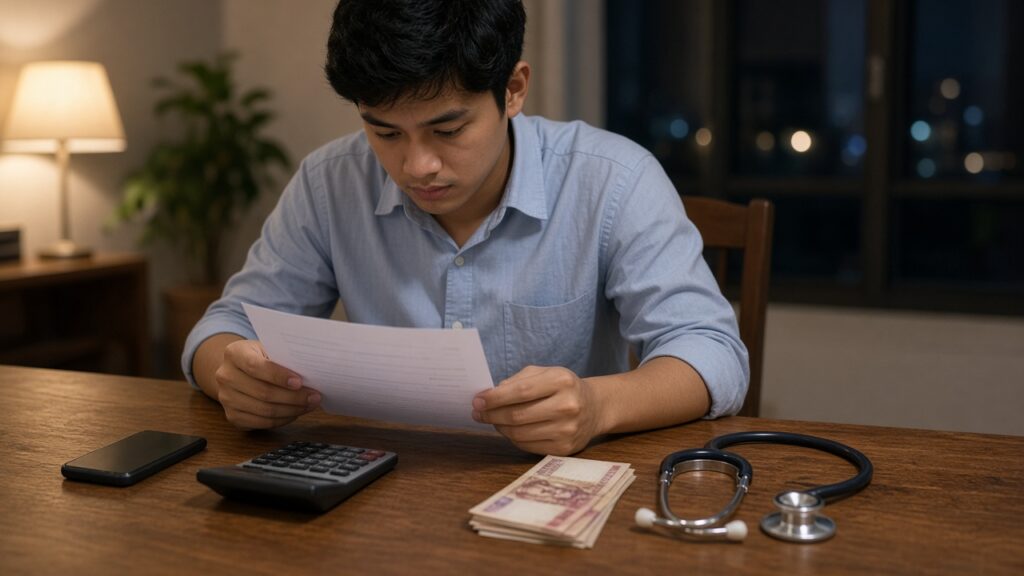
Every payday, there is a line on your payslip labeled “PhilHealth” that quietly takes a few hundred pesos. Most of us only think about it when someone in the family gets confined and the hospital asks, “May PhilHealth ka ba?” If your contributions are complete and posted, PhilHealth can reduce your hospital bill. If they are missing, you may end up scrambling. And if you are a freelancer, online seller or OFW, nobody deducts it for you, so you need to know exactly how much to pay and where. This guide explains the PhilHealth contribution for 2026, how to compute your share, and how to pay and check your records.
What your PhilHealth contribution pays for
PhilHealth, the Philippine Health Insurance Corporation, runs the National Health Insurance Program. Your monthly premium is what keeps you, and your qualified dependents, eligible for PhilHealth benefits such as hospital confinement coverage under case rates, outpatient and primary care programs, and special benefit packages. It is not a savings account, so you will not get it back like Pag-IBIG savings, but it works like health insurance that the whole country shares.
Under the Universal Health Care (UHC) Act, or Republic Act No. 11223, everyone is automatically a PhilHealth member. Members who earn income are called direct contributors, and they pay premiums. This includes employees, self-employed people, professionals, freelancers and OFWs.
The PhilHealth contribution rate for 2026
For 2026, the premium stays at 5% of your monthly basic income, with an income floor of ₱10,000 and an income ceiling of ₱100,000. According to the Philippine Information Agency, PhilHealth said the 5% rate is the final scheduled adjustment under the UHC Act, and PhilHealth’s Northern Mindanao office confirmed premiums will not increase in 2026. The same schedule appears in PhilHealth’s own Advisory No. 2025-0002 and is applied to OFWs and other direct contributors in Advisory No. 2026-0042.
- Monthly income of ₱10,000 and below: fixed monthly premium of ₱500.
- Monthly income of ₱10,000.01 to ₱99,999.99: 5% of your monthly income, so from ₱500 to ₱5,000.
- Monthly income of ₱100,000 and above: maximum monthly premium of ₱5,000.
For employed members, the premium is shared equally between you and your employer. For self-paying members such as freelancers and self-employed people, the premium is based on your declared monthly income and you pay the full amount.
What counts as “monthly basic salary” for employees
This part trips up a lot of people. PhilHealth’s advisory reminds employers to use the Monthly Basic Salary (MBS), which is your fixed basic rate. It does not include sales commissions, overtime pay, allowances, 13th month pay, bonuses or other gratuity payments. Deductions for undertime, tardiness, leave without pay or absences are also excluded from the computation.
So if your basic pay is ₱20,000 and you also get a ₱3,000 rice and transport allowance, your PhilHealth premium is computed on ₱20,000 only. Your 13th month pay does not raise your PhilHealth premium either.
Sample computations
The formula is simple: premium = 5% × monthly basic income, where income below ₱10,000 is counted as ₱10,000 and income above ₱100,000 is counted as ₱100,000. Here are a few examples for employees, where the premium is split in half:
- Basic salary of ₱8,000: below the floor, so the premium is ₱500. You pay ₱250 and your employer pays ₱250.
- Basic salary of ₱18,000: 5% of ₱18,000 is ₱900. You pay ₱450 and your employer pays ₱450.
- Basic salary of ₱25,000: 5% of ₱25,000 is ₱1,250. You pay ₱625 and your employer pays ₱625.
- Basic salary of ₱150,000: above the ceiling, so the premium is capped at ₱5,000. You pay ₱2,500 and your employer pays ₱2,500.
For a self-paying member, there is no employer share. A freelancer declaring ₱30,000 a month pays the full ₱1,500 premium. That same example appears in PhilHealth’s Advisory No. 2026-0042, which shows ₱4,500 for a quarter, ₱9,000 for six months and ₱18,000 for a full year.
If you are a freelancer, self-employed or an OFW
When you leave employment to start freelancing or open a small business, your PhilHealth does not pause on its own. You become a self-paying direct contributor. A few things to keep in mind:
- Update your membership category. Let PhilHealth know you are now self-employed or a professional, so your records match how you are paying. You can ask at any PhilHealth Local Health Insurance Office (LHIO).
- Declare your income honestly. Your premium is based on your declared monthly income. The minimum is ₱500 a month.
- OFWs pay 5% too. Advisory No. 2026-0042 states that direct contributors, including OFWs, pay 5% of monthly income. It also notes that OFWs and their dependents abroad may claim reimbursement for overseas confinement at the applicable case rate, filed within 180 days from discharge.
How often and where to pay
Based on PhilHealth’s Advisory No. 2026-0042, premium contributions can be paid monthly, quarterly, semi-annually or annually through PhilHealth-accredited collecting agents, both in the Philippines and abroad. Employees do not need to do anything, since the employer deducts and remits the premium.
If your cash flow is irregular, which is common for freelancers and online sellers, paying a quarter or six months at a time can help you avoid missed months. Pick the schedule you can keep consistently. Treat it like a fixed bill in your budget, just like your SSS contribution and Pag-IBIG contribution.
Only pay through PhilHealth’s own offices or its accredited collecting partners, and always keep your official receipt or transaction reference. Never hand cash to someone on Facebook who offers to “update” or “fix” your PhilHealth for a fee. If something sounds off, read our guide on how to spot money scams in the Philippines.
How to check if your contributions are posted
Paying is only half the job. PhilHealth advises members to verify the posting of their premium contributions through the PhilHealth Member Portal or the eGov PH Super App. It is a good habit to check every few months, especially if:
- you recently changed employers,
- you shifted from employee to freelancer or self-employed,
- you paid through a new channel for the first time, or
- someone in your family may need hospital care soon.
If your payments are missing, bring your receipts to the nearest LHIO, or contact the PhilHealth Corporate Action Center at (02) 8662-2588 or [email protected], as listed in the advisory. For employees, ask HR first, since the employer is responsible for remitting both shares.
Practical tips to stay covered
- Check your payslip. Your PhilHealth deduction should be half of 5% of your basic salary, within the floor and ceiling. If it looks wrong, ask HR how it was computed.
- Keep your member data updated. Update your contact details and declared dependents so you get advisories and can use benefits without delay.
- Budget it before you spend. Freelancers can set aside ₱500 or more per month in a separate account, so the premium is ready when it is due.
- Do not rely on PhilHealth alone. PhilHealth helps lower hospital bills, but it may not cover everything. An emergency fund is still your best protection against surprise medical costs.
- Save your PhilHealth Identification Number (PIN). Keep it in your phone notes so every payment goes to the right record.
The bottom line
For 2026, the PhilHealth premium is 5% of your monthly basic income, from a minimum of ₱500 to a maximum of ₱5,000 a month. Employees split it with their employer, while freelancers, self-employed people and OFWs pay the full amount. Know your rate, pay through official channels on a schedule you can keep, and check your posted contributions regularly so your coverage is there when your family needs it.
This article is general information only and not financial advice. Rates, rules and fees change, so please verify with the provider or the official agency before deciding.