Every Filipino household knows the feeling. Sahod arrives, the bills get paid, and then out of nowhere comes the school enrollment fee, the car registration, the ninong and ninang season, or the fiesta handaan. None of these are true emergencies. You knew they were coming. They just arrive all at once, and they wipe out the month.
The fix is simple and old-fashioned: a sinking fund. It is one of the most practical money habits you can build in the Philippines, and you can start with whatever amount you have this payday.
What is a sinking fund?
A sinking fund is money you set aside little by little for a specific, expected expense. Instead of paying ₱12,000 in one painful month, you save ₱1,000 a month for twelve months, so when the bill arrives the money is already waiting.
Think of it as the grown-up version of the alkansya, except each alkansya has a name and a target date.
Sinking fund vs. emergency fund
People often mix these up, but they do different jobs:
- Emergency fund is for things you cannot predict: losing your job, a hospital stay, a sudden repair after a typhoon. Read our guide on how to build an emergency fund on a Philippine salary.
- Sinking fund is for things you can predict, even if you do not know the exact amount: tuition, insurance premiums, gifts, travel, gadget replacement.
The two work together. When your sinking funds cover the expected costs, your emergency fund stays untouched for real emergencies. Without sinking funds, many families end up “borrowing” from their emergency fund every few months and never seem to build it up.
Common sinking funds for Filipino households
You do not need all of these. Pick the ones that match your life:
- School expenses: enrollment, books, uniforms, projects, field trips.
- Christmas and gifts: Noche Buena, inaanak, exchange gifts, and the bonus-season temptations. Pair this with our Christmas budget guide.
- Birthdays and special occasions: handaan, binyag, kasal, and the regalo you always end up buying.
- Vehicle costs: yearly registration, insurance renewal, change oil, tires, and repairs.
- Home maintenance: aircon cleaning, plumbing, repainting, roof checks before rainy season.
- Health and wellness: dental, eyeglasses, annual check-ups, and maintenance medicine not covered by your HMO.
- Insurance premiums and annual fees: life insurance, HMO for family members, credit card annual fees, subscriptions billed yearly.
- Gadget replacement: phones and laptops eventually die. Save for the next one before the current one breaks.
- Travel and homecoming: Holy Week, undas, or the trip back to the province.
- Padala and family support: if you regularly help relatives with tuition or bills, a dedicated fund keeps it from surprising your budget.
How to set up a sinking fund in 5 steps
Step 1: List your expected expenses for the next 12 months
Go through your calendar and last year’s spending. Check old receipts, your GCash or Maya transaction history, and your bank statements. Write down every expense that happens once or a few times a year.
Step 2: Estimate the amount and the due date
Use last year’s actual amount and add a small buffer, because prices tend to go up. If you are unsure, call the school, check your insurance policy, or look at your previous registration receipt. Use real figures from your own bills, not guesses.
Step 3: Divide by the number of months (or paydays) left
The formula is simple:
Amount needed ÷ months until due = monthly savings
Here is an example with made-up numbers for a family, just to show the math:
- School expenses of ₱18,000 due in 8 months: ₱18,000 ÷ 8 = ₱2,250 a month
- Christmas fund of ₱10,000 due in 10 months: ₱10,000 ÷ 10 = ₱1,000 a month
- Car registration and insurance of ₱15,000 due in 12 months: ₱15,000 ÷ 12 = ₱1,250 a month
- Gadget fund of ₱12,000 over 24 months: ₱12,000 ÷ 24 = ₱500 a month
Total: ₱5,000 a month. If you are paid every kinsenas (15th and 30th), that is ₱2,500 per payday.
If the total feels too big, that is useful information too. It tells you that your current budget was never really covering these costs; they were simply being paid with credit cards, loans or the emergency fund. Trim the targets, stretch the timelines, or drop a fund for now, but be honest about it.
Step 4: Choose where to keep the money
The best place is somewhere safe, easy to track, and slightly inconvenient to spend. Some options:
- Separate bank savings accounts. Many banks let you open more than one account, and some digital banks let you create multiple savings “pockets” or goals inside one app. Name each one after its purpose.
- E-wallet savings features, such as GCash GSave or Maya Savings, which are deposit accounts with partner banks. See our guide on saving with GCash GSave or Maya Savings.
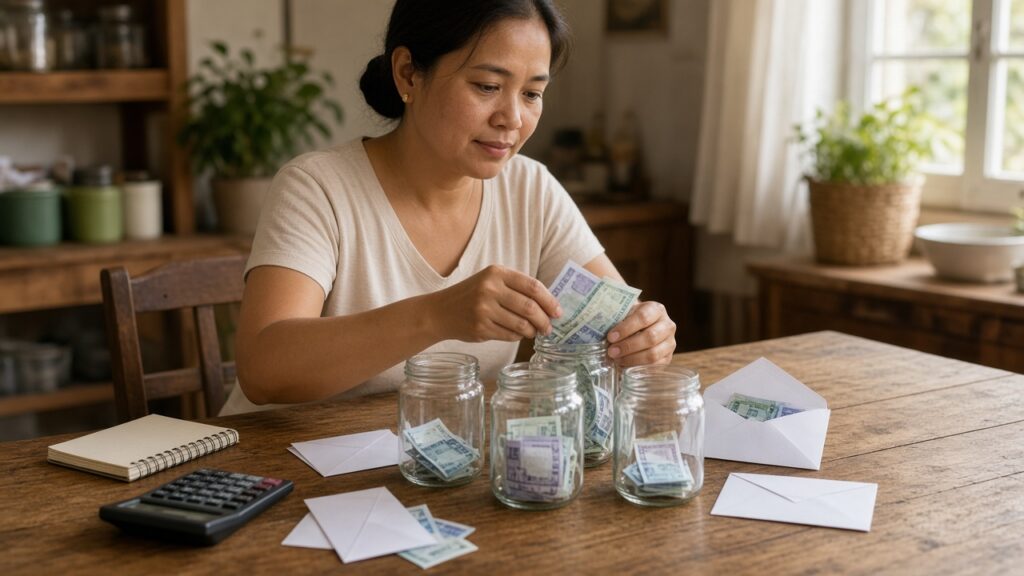
- Labeled envelopes or jars at home for small, near-term funds. This works for some people, but cash at home earns nothing, can be lost or stolen, and is very easy to “borrow” from.
For larger amounts, keep your money in a bank. Deposits in banks licensed by the Bangko Sentral ng Pilipinas are insured by the Philippine Deposit Insurance Corporation (PDIC) up to ₱1 million per depositor, per bank, effective March 15, 2025. Note that this covers deposits, not investment products, and PDIC says deposits in cooperatives and non-stock savings and loan associations are not covered. Our explainer on whether digital banks are safe goes into more detail.
Interest rates on savings accounts and e-wallet savings change often and may come with conditions, so check the current rate and terms in the app or on the bank’s website before choosing. For a sinking fund, safety and easy access matter more than squeezing out the highest rate. For goals that are several years away, you can compare longer-term options in our MP2 vs. time deposit guide, but remember that locked-in products are not ideal for money you need within the year.
Step 5: Automate it on payday
The habit only works if it happens before you spend. On payday, move the sinking fund amount first, together with your emergency fund savings, then live on what is left. If your bank or app allows scheduled transfers, set them up so you do not have to remember.
Tips to make sinking funds actually work
- Start small. One fund for the next big expense is better than ten funds you abandon in a month. Add more once the first one feels normal.
- Use windfalls wisely. Your 13th month pay, bonuses, or side income can jump-start several funds at once. Our 13th month pay guide shows how to plan it.
- Keep a simple tracker. A notebook or spreadsheet with each fund’s target, current balance and due date is enough. Seeing the numbers grow is motivating.
- Do not raid one fund for another. If the school fund keeps paying for gadgets, you will be short when enrollment comes. Move money between funds only on purpose, and write it down.
- Review every few months. Prices change, kids grow, and plans shift. Adjust targets when you learn the real amount.
- Celebrate when you pay in full. Paying a ₱15,000 bill in cash with zero stress is the whole point. Notice that feeling; it is why you are doing this.
What if you have debt?
If you are paying high-interest debt like credit card balances or loans, you might wonder if sinking funds should wait. In most cases, a small sinking fund for unavoidable expenses actually helps you get out of debt, because it stops new borrowing every time a predictable bill shows up. Keep the funds modest, focus extra money on debt, and see our guide on the debt snowball vs. avalanche methods. If you use credit cards, our tips on using a credit card wisely pair well with this habit.
A word of caution
A sinking fund is a savings habit, not an investment. Be wary of anyone who offers to “grow” your school or Christmas fund with promised high returns through paluwagan schemes run by strangers, online “investment” groups, or apps that are not registered. If an offer promises guaranteed high income or fast returns, treat it as a red flag. Check if a company is authorized with the SEC or BSP before you hand over any money, and read our guide on how to spot money scams in the Philippines.
Quick sinking fund checklist
- List all expected non-monthly expenses for the next 12 months
- Estimate each amount using real past bills, plus a small buffer
- Divide by months or paydays left to get your savings amount
- Keep each fund in a named bank account, savings pocket or envelope
- Transfer on payday, before spending
- Track balances and review every few months
Predictable expenses should not feel like emergencies. With a few named funds and a payday habit, the next enrollment, registration or Christmas season can be just another planned item in your budget.
This article is general information only and not financial advice. Rates, rules and fees change, so please verify with the provider or the official agency before deciding.