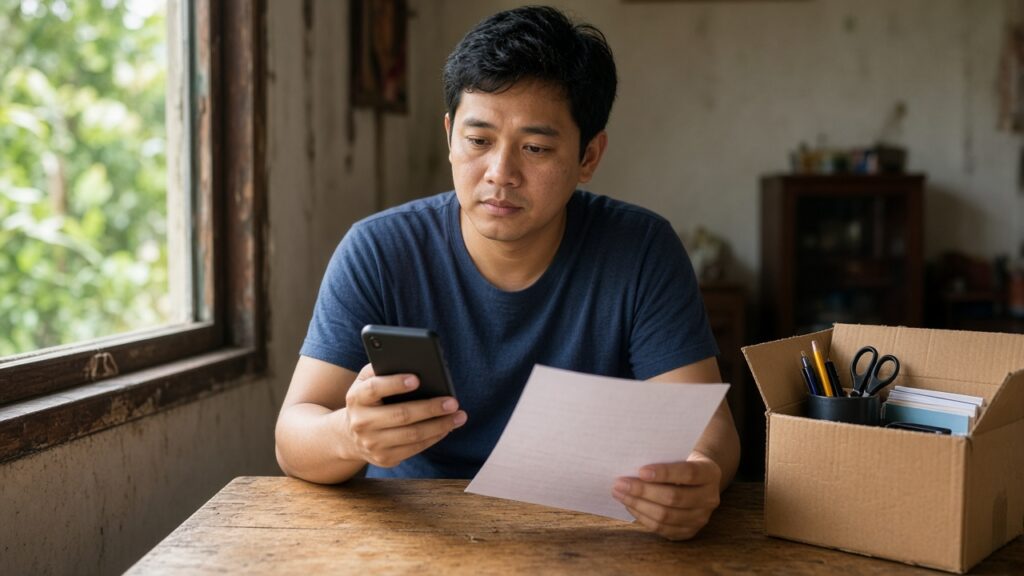
Losing a job is one of the scariest things that can happen to a Filipino household. Rent, kuryente, tuition and the daily ulam do not pause just because the payslips stopped. The good news is that if you are an SSS member and you lost your work through no fault of your own, you may be able to claim the SSS unemployment benefit, also called the involuntary separation benefit.
It will not replace your salary, and it is only for a short time. But it is money you have already earned through your contributions, and many qualified members never claim it because they do not know it exists or think the process is too complicated. This guide walks you through who qualifies, how much you can expect, and how to file online.
What is the SSS unemployment benefit?
The unemployment benefit was created under the Social Security Act of 2018 (Republic Act No. 11199). SSS describes it as a cash benefit for covered employees, including kasambahay and Overseas Filipino Workers, who are involuntarily separated from employment and meet the eligibility requirements. You can read the full rules on the official SSS Unemployment Benefit page.
The key word is involuntary. The benefit is meant for people who lost their job because of things like retrenchment, redundancy or a company closing down, not for people who simply decided to resign.
Who qualifies?
According to SSS, you must meet all of these conditions:
- Age: You are not over 60 years old at the time of separation. The limit is 50 for underground or surface mineworkers and 55 for racehorse jockeys.
- Contributions: You have paid at least 36 monthly contributions, and at least 12 of those were paid in the 18 months right before the month you were separated.
- No recent claim: You have not received a settled unemployment benefit in the last three years before your separation.
- Involuntary separation: You lost your job for a reason that counts as involuntary under SSS and DOLE rules.
Not sure about your contribution count? Log in to My.SSS and check your contribution records first. If there are gaps, our guide on SSS contribution rates and how to pay explains how contributions work.
What counts as involuntary separation?
The SSS page lists several situations, including:
- Authorized causes under the Labor Code, such as installation of labor-saving devices, redundancy, retrenchment or downsizing, closure or cessation of operations, and an illness that legally prevents you from continuing to work.
- Certain resignations that are not truly voluntary, for example when an employee resigns immediately because of serious insult, inhuman treatment, or a crime committed by the employer against the employee or their family. SSS notes that you must back these up with substantial evidence.
- Economic downturn and natural or human-induced calamities.
- Termination for just causes is a separate case and depends on the employer’s compliance with due process, as spelled out in the SSS rules.
SSS also clarifies some situations that do not count. Employees on floating status who are still waiting to be recalled are not yet considered involuntarily separated. OFWs with a perfected contract who were never deployed are also not covered. Plain voluntary resignation, like leaving for a better offer, does not qualify.
How much is the benefit?
Under RA 11199, a qualified member receives monthly cash payments equal to 50% of their average monthly salary credit (AMSC), for a maximum of two months. Your salary credit is the compensation bracket SSS uses for your contributions, not necessarily your exact salary.
Here is a simple example to show how the math works. This is only an illustration; your actual amount depends on your own contribution record.
- Suppose your average monthly salary credit is ₱20,000.
- 50% of ₱20,000 is ₱10,000 per month.
- For two months, that is ₱20,000 in total.
That is helpful, but it is clearly not enough to live on for long. Think of it as bridge money while you look for your next job, not as a replacement income. SSS will show the computed amount when your claim is processed.
What you need before filing
SSS says unemployment benefit claims must be filed online through your My.SSS account. Before you start, make sure you have:
- A registered My.SSS account with updated email and mobile number.
- A UMID card enrolled as ATM, or an approved disbursement account enrolled in the Disbursement Account Enrollment Module (DAEM) of My.SSS. This can be a bank account or another channel accepted by SSS.
- Your date of separation and your employer’s SSS-registered name.
- Your Notice of Termination from your employer. If you cannot get one, GMA News’ explainer notes that a notarized Affidavit of Termination may be presented at DOLE instead.
- A valid government ID.
How to file, step by step
Step 1: File your claim on My.SSS
Log in to My.SSS, go to the Benefits tab and click Unemployment Benefit. You will be asked to confirm your disbursement account, choose your employment category (covered employee or kasambahay, mineworker, racehorse jockey, sea-based or land-based OFW), and enter your separation date and employer. You will also pick the DOLE field or provincial office, or the POEA or overseas labor office for OFWs, where you will get your certification.
The system checks your eligibility and contact details. Once you confirm, SSS emails you a transaction number.
Step 2: Get your Certification of Involuntary Separation
Here is the step people miss. According to SSS, you have 30 calendar days after your online filing to apply for the electronic Certification of Involuntary Separation from DOLE (or POEA or the overseas labor office for OFWs). If you miss this window, your claim is automatically cancelled and you have to file again. SSS says it sends a reminder email one week before cancellation.
Local employees and kasambahay go to the DOLE office where the employer is located. Bring your SSS transaction number, a valid ID and your Notice of Termination. SSS states that DOLE certifies within three working days once your documents are complete, and you no longer need to bring a printout back to SSS.
Step 3: Wait for approval and crediting
Once DOLE confirms your certification electronically, SSS processes the claim and emails you when it is approved and credited to your disbursement account.
Important deadlines and limits
- File within one year from the date of your involuntary separation.
- You can only claim the benefit once every three years.
- If you are rehired within two months of separation, or a case later shows you were validly dismissed for just cause or you were reinstated with backwages, SSS may deduct the benefit from your future SSS benefits.
- False claims are referred for investigation and can lead to liability under RA 11199. Do not let anyone “fix” your papers for a fee.
Practical money moves after losing a job
The SSS benefit is just one piece. While you look for work, these steps can help you stretch every peso:
- Check your final pay and separation pay. These come from your employer and are separate from the SSS benefit. Ask HR for a breakdown and check DOLE guidance if something looks wrong.
- Switch to a bare-bones budget. List only the essentials: rent, food, utilities, transport for job hunting, and minimum loan payments. Pause subscriptions and big purchases.
- Use your emergency fund wisely. This is exactly what it is for. If you do not have one yet, our guide on building an emergency fund on a Philippine salary can help once you are back on your feet.
- Talk to your lenders early. If you have an SSS salary loan or a bank loan, ask about restructuring before you miss payments.
- Keep your contributions going if you can. If you start freelancing or a small business, you can continue paying as a self-employed or voluntary member so your record stays strong.
- Watch out for scams. Job seekers are prime targets for fake job offers, “processing fee” schemes and online lending apps. Never pay to get hired.
Bottom line
The SSS unemployment benefit will not solve everything, but up to two months of support at 50% of your average salary credit can buy you breathing room while you job hunt. If you were laid off, retrenched or your company closed, check your eligibility on My.SSS right away, file online, and remember to get your DOLE certification within 30 days. It is your money, so claim it.
This article is general information only and not financial advice. Rates, rules and fees change, so please verify with the provider or the official agency before deciding.