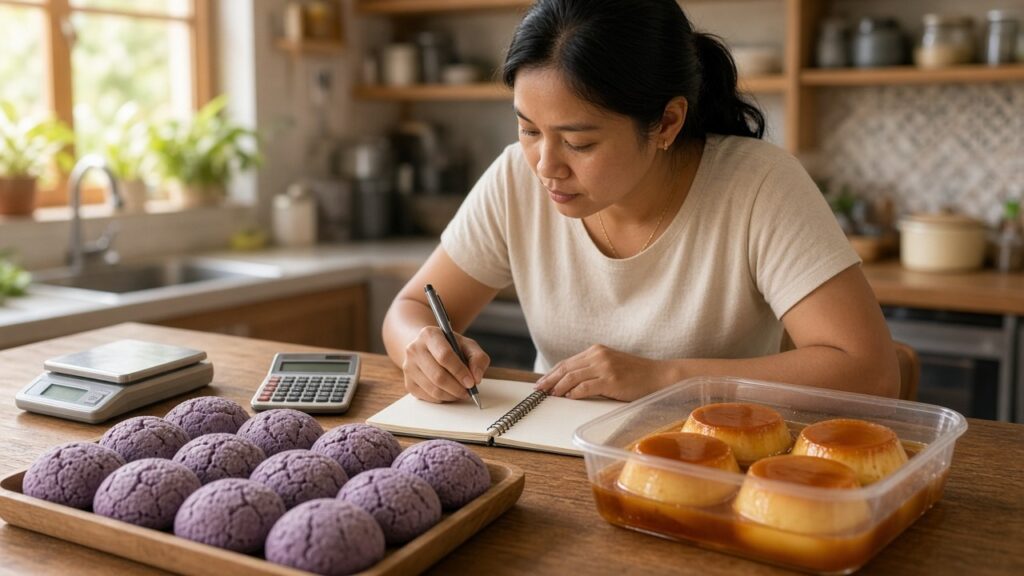
Your leche flan is the star of every handaan. Your officemates keep asking for your ube crinkles. Sooner or later someone says, “Ibenta mo na ‘yan!” Selling homemade food is one of the most common side hustles in Filipino households, and it can work. But many home sellers quietly lose money because they price by feel: “Mga ₱300 siguro, para hindi mahal.” If the price does not cover ingredients, packaging, gas and your own time, every order is just you paying to stay busy.
This guide shows a simple way to price homemade food products in the Philippines, with a worked example in pesos, how to protect your profit when you give discounts, and the permits you should know about. A quick honest note first: home food selling is real work with real costs. Some sellers earn a steady extra income, many earn modest amounts, and some stop after a few months. Treat it as a small business, not a sure thing.
Step 1: List every cost, not just the ingredients
The most common pricing mistake is counting only what you bought at the palengke or grocery. Your real cost per piece has five parts:
- Ingredients. Everything that goes into one batch: flour, sugar, eggs, butter, ube halaya, milk, flavorings. Use your actual receipts, not guesses, and update them when prices change.
- Packaging. Boxes, tubs, llaneras, stickers, ribbons, paper bags, utensils and tissue. Packaging is often bigger than people expect, especially for small items.
- Utilities. LPG or electricity for baking, steaming or chilling. An estimate per batch is fine as long as you do not leave it out.
- Your labor. Prepping, cooking, cooling, packing, answering messages and meeting riders all take time. Decide on an hourly rate you would accept for that work and include it.
- Waste and allowance. Burnt trays, broken pieces, taste tests and freebies for family happen. A small allowance, such as 5% of ingredient cost, keeps them from eating your profit.
Divide each cost by the number of pieces the batch produces to get the cost per piece.
Step 2: A worked example in pesos
Here is a sample computation for one batch of 40 ube crinkles sold in boxes of 10. These are example figures only. Your ingredient prices, yields and costs will be different, so plug in your own receipts.
| Cost item (sample) | Per batch of 40 | Per piece |
|---|---|---|
| Ingredients | ₱560.00 | ₱14.00 |
| Packaging (4 boxes at ₱30) | ₱120.00 | ₱3.00 |
| LPG or electricity estimate | ₱60.00 | ₱1.50 |
| Labor (3 hours at ₱100 per hour) | ₱300.00 | ₱7.50 |
| Waste allowance (5% of ingredients) | ₱28.00 | ₱0.70 |
| Total cost | ₱1,068.00 | ₱26.70 |
So one box of 10 costs ₱267.00 to make before any profit. If you had priced it at ₱250 because “mukhang tama,” you would be losing ₱17 per box, and you would not even notice because the cash still comes in.
Step 3: Add profit using margin, not just markup
Two words get mixed up a lot:
- Markup is profit as a percentage of your cost. A 30% markup on ₱267 is ₱80.10, so the price would be ₱347.10.
- Margin is profit as a percentage of your selling price. To get a 30% margin, divide cost by 0.70: ₱267 ÷ 0.70 = ₱381.43.
Margin is the safer way to think, because discounts, reseller cuts and fees are taken from the selling price. In the example, a 30% margin gives about ₱381, which you could round to a cleaner ₱390 per box. At ₱390, your profit is ₱123 per box, or roughly 31.5% of the price, on top of the ₱75 labor you already paid yourself in the cost.
There is no single “correct” margin for food. It depends on your product, your competition and how much effort each order takes. Pick a target, test it, and review it after a month of real sales.
Step 4: Check the price against the market
Your formula gives you a floor, the lowest price that still makes sense. Next, look at what similar sellers in your area charge on Facebook Marketplace, community groups and food pages. Compare the same size, quality and packaging, not just the product name.
- If others sell much cheaper, find out why before you cut your price. They may use cheaper ingredients, smaller portions, or simply not count their labor.
- If your cost is above what buyers will pay, adjust the product instead of selling at a loss: change the size, the packaging, the recipe or the order minimum.
- If you are clearly better, with premium ingredients, nicer packaging or reliable on-time delivery, you can price above average. Many buyers pay more for consistency.
Step 5: Plan for discounts, resellers and bundles
Before you agree to “pa-discount naman” or a reseller deal, run the numbers. Using the sample box priced at ₱390 with a cost of ₱267:
- A 10% discount (₱351) leaves ₱84 profit per box.
- A 20% reseller price (₱312) leaves only ₱45 per box.
- A 30% discount (₱273) leaves just ₱6 per box, which is basically working for free.
Some sellers set a separate reseller price with a minimum order, so the bigger volume makes up for the smaller profit per box. If you sell through a delivery or marketplace platform, read its current commission and fee terms first and build them into the price for that channel. Many sellers simply post a slightly higher price on platforms than for direct orders.
Step 6: Know your break-even point
Besides per-piece costs, you may have monthly costs that do not change with each batch, such as a permit you are setting aside for, a chest freezer you are paying off, or boosted posts. Divide these by your profit per unit to see how many you need to sell just to break even.
Example: if your sample monthly fixed costs are ₱1,500 and your profit is ₱123 per box, you need about 13 boxes a month (₱1,500 ÷ ₱123 = 12.2, rounded up) before you earn anything extra. If you only sell 8 boxes a month, you either need more orders, lower fixed costs, or a different price.
Step 7: Getting paid and keeping records
- Ask for payment upfront or a downpayment for custom or bulk orders, especially for first-time buyers. Confirm GCash, Maya or bank transfers in your own app, not from a screenshot the buyer sends.
- Keep a simple notebook or spreadsheet of sales, ingredient purchases and expenses. Even a basic record shows you which products actually make money.
- Separate business money from household money. A dedicated e-wallet or savings account, such as those covered in our GCash GSave and Maya Savings guide, makes it easier to see your real profit and to set aside money for restocking.
Permits and taxes: what to check
Selling food is regulated, even if you start from home. Here is what to look into, depending on how big you grow:
- Business name and local permits. Sole proprietors register a business name with the DTI through its Business Name Registration System, then secure a barangay clearance and mayor’s permit from the LGU. Our guide on how to register an online business in the Philippines walks through the steps.
- BIR registration. Income from selling food is taxable business income. Self-employed individuals register with the Bureau of Internal Revenue. If you qualify and choose the 8% income tax option, the first ₱250,000 of annual gross sales is not taxed; see our explainer on the BIR 8% tax option.
- FDA License to Operate. The Food and Drug Administration licenses establishments that manufacture, repack, distribute or sell processed food, and its FDA FAQs explain who must apply. Applications go through the FDA eServices Portal. Some products may also need product registration before they can be sold widely. Whether your specific setup is covered depends on what you make and how you sell it, so confirm directly with the FDA before scaling up, joining bazaars or supplying stores.
Permits cost money and time, so include them in your fixed costs once you go official. That is another reason pricing by feel rarely works.
Quick pricing checklist
- Compute cost per piece with ingredients, packaging, utilities, labor and waste.
- Set a target margin and divide cost by (1 minus margin).
- Compare with similar sellers, and adjust the product, not just the price.
- Pre-compute what discounts and reseller prices leave you.
- Know your monthly break-even.
- Review your costs whenever ingredient prices move.
Done right, pricing lets your homemade food pay you fairly for your time instead of quietly draining your budget. Start small, keep records, and grow only when the numbers show it is worth it. And keep your emergency fund separate from your puhunan so one slow month does not hurt your household.
This article is general information only and not financial advice. Rates, rules and fees change, so please verify with the provider or the official agency before deciding.