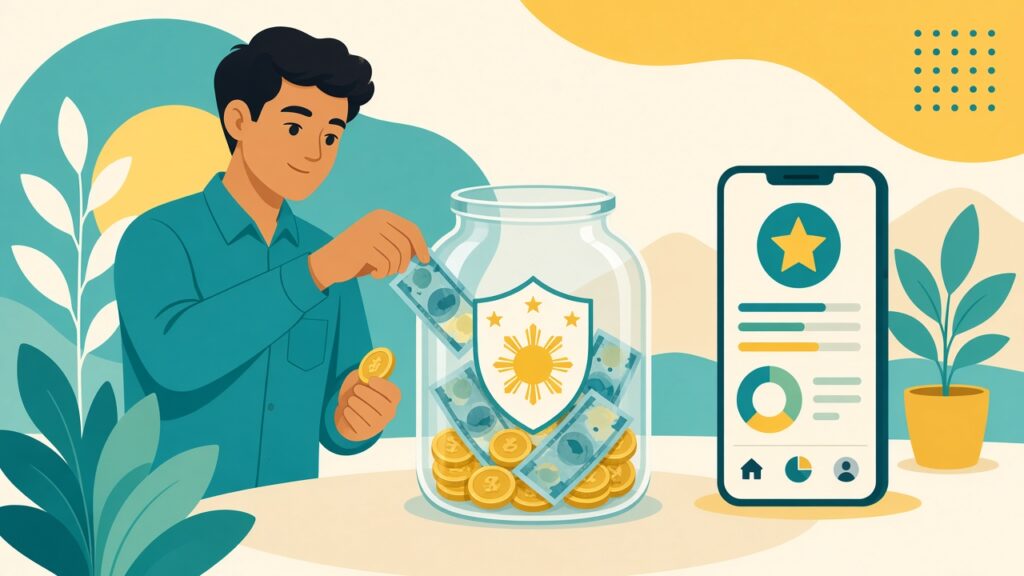
A typhoon floods your boarding house. Your phone dies the week before payday. A parent in the province gets admitted to the hospital. Emergencies like these do not wait for your next sahod, and without savings the usual fallback is a high-cost loan or a borrowed amount you spend months paying back. An emergency fund is simply cash set aside for the unexpected, so one bad week does not become a bad year.
This guide walks you through building one on a regular Philippine salary, with peso examples, a place to keep the money, and a sample budget you can adapt.
Panoorin: quick video tip
What counts as an emergency (and what does not)
An emergency fund is for events that are unexpected, necessary and urgent:
- Sudden loss of income (end of contract, illness, business slowdown)
- Medical or dental costs that PhilHealth or HMO does not fully cover
- Urgent home or phone repairs you need for work
- Emergency travel, for example a family crisis in the province
- Damage from typhoons, floods or fire
It is not for a sale at the mall, a new phone upgrade, or the barkada trip. Those belong in your “wants” or a separate sinking fund. Keeping the two apart is what stops the emergency fund from quietly disappearing.
Step 1: Know your monthly “must-pay” number
Your target is based on what you must spend to live, not on your full salary. Add up the essentials for one month:
- Rent or boarding house share, or housing loan
- Groceries and basic food
- Transport to work
- Electricity, water, internet and load
- Insurance premiums, required contributions and minimum loan payments
- Regular support for family, if that is a fixed part of your life
Use your last two or three months of GCash, Maya or bank transactions to check the real numbers, not what you guess. In the sample budget below, this “must-pay” figure is ₱12,500 a month.
Step 2: Pick your target (3 to 6 months is a common rule of thumb)
Many personal-finance guides suggest keeping three to six months of essential expenses. It is a rule of thumb, not a law, so adjust it to your situation. Using the ₱12,500 example:
| Goal | Months of essentials | Amount |
|---|---|---|
| Starter cushion | About 2 weeks | ₱5,000 to ₱10,000 |
| Basic fund | 3 months | ₱37,500 |
| Stronger fund | 6 months | ₱75,000 |
Aim for the higher end if:
- Your income is irregular (freelance, commission, seasonal work)
- Other people depend on your income
- You are the only earner in the household
- You live in an area that often floods or is hit by typhoons
A three-month target may be enough if you have a stable job, no dependents and family who can realistically help in a crisis.
Step 3: Start small, then build in stages
₱75,000 can look impossible, so break it up:
- Stage 1: ₱5,000 to ₱10,000. This covers small shocks like a phone repair or a clinic visit so you do not reach for a loan app.
- Stage 2: one month of essentials (₱12,500 in the example).
- Stage 3: three months (₱37,500).
- Stage 4: up to six months (₱75,000), if it fits your situation.
How long it takes depends on how much you can put away. At ₱3,000 a month, ₱37,500 takes about 12 to 13 months. At ₱1,500 a month, it takes about 25 months. A smaller monthly amount is fine as long as it is consistent.
Step 4: Automate and pay yourself first
Do not wait to see what is left at the end of the month; there is usually nothing left. Instead:
- Set up a recurring transfer on the day after payday.
- If your bank or e-wallet allows scheduled transfers, use them. If not, set a phone reminder and transfer the same day you get paid.
- Send the money to a separate account, not your spending account.
- Add windfalls: a share of your 13th-month pay (if you are entitled to it), bonuses, tax refunds or side income.
Step 5: Choose where to keep it
An emergency fund has one job: be there when you need it. That makes safety and liquidity more important than earning the highest interest. Do not put it in anything that can lose value, is locked up, or is hard to cash out quickly. That rules out stocks, crypto and “investment” schemes for this money.
| Option | Pros | Watch out for |
|---|---|---|
| Regular savings account in a bank | Easy to access; deposits are insured by PDIC | Maintaining balance and low interest; ATM fees |
| Digital bank savings account | No branch needed; often no or low minimum balance; instant transfers | Confirm it is a licensed bank and check its PDIC coverage; read the terms for fees and limits |
| E-wallet balance (GCash, Maya, etc.) | Very convenient for small amounts | E-money is not a deposit and is not PDIC-insured; also too easy to spend |
| Time deposit or locked savings | Higher interest, forces discipline | Early withdrawal penalties; not ideal for the first layer of your fund |
About PDIC. The Philippine Deposit Insurance Corporation (PDIC) insures eligible deposits in banks up to ₱1,000,000 per depositor, per bank, effective March 15, 2025 (PDIC). Deposits in non-banks such as cooperatives are not covered (PDIC FAQ). Also, under BSP rules e-money is not considered a deposit and is not insured by PDIC (BSP Manual of Regulations, Section 702). Some apps offer savings features that are actually run by a partner bank, so check which institution holds your money.
A simple, practical setup for many people:
- A small buffer (₱3,000 to ₱5,000) in your e-wallet for urgent small payments.
- The rest in a separate bank or digital bank savings account that is not linked to your daily spending, with no debit card in your wallet if possible.
- Optional: once you have reached three months, you may place part of the extra in a short-term product, as long as you can still reach at least one month of essentials immediately.
Interest rates change often and differ per bank, so check the current rate and fees directly with the provider.
Sample monthly budget using 50/30/20 (example only)
The 50/30/20 rule is a simple guide: about 50% of take-home pay for needs, 30% for wants and 20% for savings and debt payments. Here is an example only for a single employee with a ₱25,000 monthly take-home pay renting a room or bedspace in a city. Your numbers will differ.
| Category | Item | Amount |
|---|---|---|
| Needs (50%) | Rent / boarding house share | ₱4,500 |
| Food and groceries | ₱4,000 | |
| Transport (commute) | ₱1,500 | |
| Electricity, water, internet and load | ₱1,500 | |
| Health, toiletries and other essentials | ₱1,000 | |
| Subtotal needs | ₱12,500 | |
| Wants (30%) | Eating out and coffee | ₱2,000 |
| Subscriptions and entertainment | ₱1,000 | |
| Shopping | ₱2,000 | |
| Hobbies, gifts and occasional trips | ₱2,500 | |
| Subtotal wants | ₱7,500 | |
| Savings (20%) | Emergency fund | ₱3,000 |
| Other goals (retirement, debt payoff, MP2, etc.) | ₱2,000 | |
| Subtotal savings | ₱5,000 | |
| Total | ₱25,000 | |
This is an illustration, not a recommendation for your exact situation.
How to adapt it to real Philippine life
- If you send money home (padala): treat it as a need if it is regular. You may end up closer to 60/20/20 or 60/25/15, and that is okay.
- If rent is higher in Metro Manila or other big cities: trim the wants first, not the savings. Even ₱1,000 a month is better than zero.
- If you carry a high-interest debt: build the starter ₱5,000 to ₱10,000 first, then split extra money between debt and the emergency fund.
- If your income is irregular: base the budget on your lowest typical month and save more in good months.
Common mistakes to avoid
- Keeping everything in your daily e-wallet. It is too easy to spend and not insured like a bank deposit.
- Using it for non-emergencies. Make a clear rule on what qualifies.
- Chasing high returns. If someone promises high, fast or “guaranteed” returns on your emergency money, treat it as a red flag. Real investments can lose value, and unregistered schemes can wipe you out.
- Never refilling. If you use the fund, rebuild it first before going back to other goals.
- Lending the fund to relatives and friends. It is okay to help, but do not let the money that protects you be tied up in someone else’s problem.
Quick action plan for this week
- Add up your essential expenses for the last 2 to 3 months.
- Set your first goal (₱5,000 to ₱10,000) and your long-term target (3 to 6 months).
- Open a separate savings account that is not your daily spending account.
- Schedule an automatic or same-day transfer after each payday, even if it is only ₱500.
- Write down what counts as an emergency so you decide before the crisis, not during it.
Building an emergency fund is not about being perfect. It is about giving your future self some breathing room. Start small and keep going.
This article is general information only and not financial advice. Rates, rules and fees change, so please verify with the provider or the official agency before deciding.