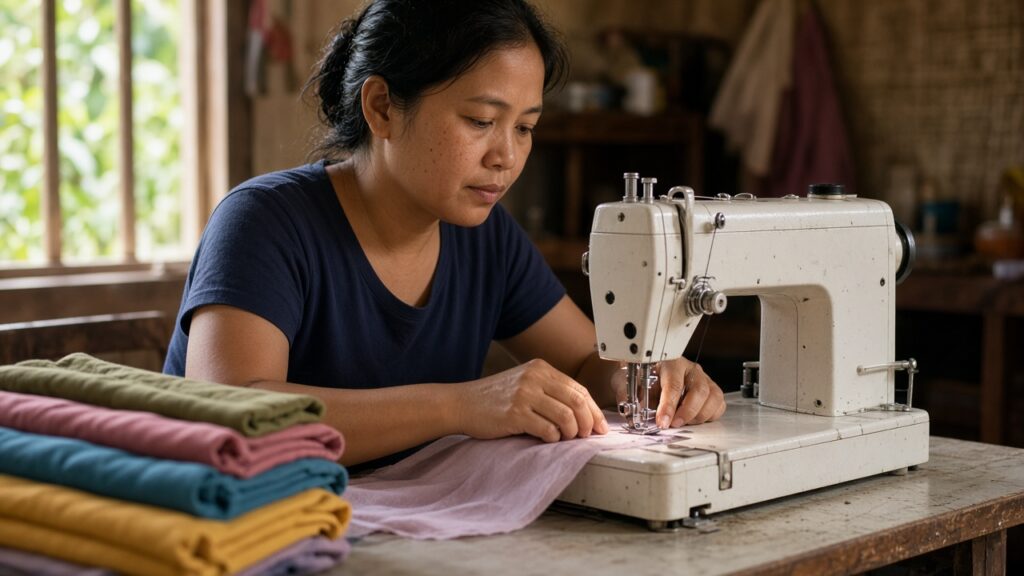
Many Filipino families have a business idea that never gets off the ground: a small sari-sari store, a kakanin stall, a backyard piggery, a sewing shop, or a few sacks of rice to retail in the barangay. The problem is almost always the same: walang puhunan. Borrowing from a “5-6” lender or an unregistered lending app to get started can bury a household in utang before the first sale.
One option that many qualified households overlook is the DSWD Sustainable Livelihood Program (SLP). It is a government program that helps poor and vulnerable families start or grow a small livelihood, or prepare for a job, through grants, training and group support. This guide explains how SLP works, who can join, what kind of help is available, how to apply, and how to avoid scams that use the program’s name.
What is the DSWD Sustainable Livelihood Program?
According to DSWD Field Office I’s official SLP page, the Sustainable Livelihood Program is a capability-building program for poor, vulnerable and marginalized households and communities. Its goal is to help them acquire the assets they need to start and maintain livelihoods that can last.
That last part matters. SLP is not a one-time ayuda where you receive cash and go home. It is designed as a process: orientation, training, forming or joining an association, preparing a project proposal, receiving the assistance, and then being monitored while the enterprise runs. If you are only looking for quick cash, this is not the right program. If you are ready to work on a small business with others in your community, it can be a real head start.
The two SLP tracks
DSWD runs SLP through two tracks. Each household can enroll a maximum of two members, pursuing two different tracks, according to the same DSWD page.
1. Microenterprise Development (MD) Track
This track is for people who want to start or expand a small business. Participants must be at least 16 years old (with written consent from a parent or legal guardian if a minor) and must be a member of a Sustainable Livelihood Program Association (SLPA). In practice, this means SLP business assistance usually flows through a group, not just to one person.
2. Employment Facilitation (EF) Track
This track is for people who prefer to be employed. It supports skills training and the costs of getting a job, such as processing requirements. EF participants must be at least 18 years old upon employment, following labor standards.
What kind of assistance can you get?
DSWD Field Office I publishes the following modalities and their cost parameters (maximum amounts, not automatic amounts):
| Modality | Track | What it covers | Cost parameter |
|---|---|---|---|
| Seed Capital Fund (SCF) | MD | Start-up capital for small tools, raw materials and common service facilities such as machinery and equipment. Given only once per participant. | Maximum of ₱15,000 per participant |
| Skills Training Fund (STF) | MD and EF | Training needed to run the enterprise (MD), or technical-vocational training fees, allowances, supplies and assessment fees (EF) | Maximum of ₱15,000 per participant |
| Cash for Building Livelihood Assets (CBLA) | MD | Stipend for participants who work on labor-intensive projects that build or protect assets needed for the livelihood | 100% of the regional minimum wage, up to 11 days |
| Employment Assistance Fund (EAF) | EF | Employment documents, medical exams, basic work tools, and transportation, meal and lodging allowance until the first 15 days of work | Maximum of ₱5,000 per participant |
Source: DSWD Field Office I – Sustainable Livelihood Program. Amounts and rules may differ by region and over time, so always confirm with your local SLP staff.
Because many SLP grants are released to associations, the total project fund can look big. For example, DSWD reported that SLP turned over ₱2.08 million in seed capital to seven livelihood associations in Jamindan, Capiz, with six associations receiving ₱300,000 each and another receiving ₱280,000. That money is for the association’s shared enterprise, not personal cash for each member.
Who can join SLP?
SLP is open to poor, marginalized, vulnerable and/or disadvantaged households, and it operates in all regions and provinces. Under the law institutionalizing the Pantawid Pamilyang Pilipino Program (Republic Act 11310), qualified 4Ps household-beneficiaries are given priority in SLP modalities, as cited on the DSWD SLP page.
If you are not a 4Ps beneficiary, that does not automatically disqualify you. Eligibility is assessed by DSWD, so the best step is to ask your local social welfare office directly instead of relying on what you read in Facebook groups.
Requirements before funds are released
Before any assistance is released, SLPAs and EF participants must receive a Certificate of Eligibility signed by the SLP Regional Program Coordinator. To get there, DSWD lists these requirements:
For the MD Track:
- Attendance at the SLP Orientation
- Attendance of all SLPA members at the Microenterprise Development Training
- Ratified SLPA Constitution and By-laws
- Signed Modality Application Form with complete attachments, if applicable
- Mungkahing Proyekto (the project proposal) signed by the Regional Director
For the EF Track:
- Attendance at the SLP Orientation
- Attendance at Basic Employment Skills Training, or other valid documents
- Signed EAF/STF Needs Assessment, Modality Application Form with attachments if applicable, and EAF Fund Utilization Commitment
- Mungkahing Proyekto signed by the Regional Director
How to apply for the DSWD SLP, step by step
- Go to your City or Municipal Social Welfare and Development Office (C/MSWDO). Say you are interested in the Sustainable Livelihood Program and ask for the SLP Project Development Officer (PDO) assigned to your area.
- Ask about the schedule of SLP activities. SLP does not usually accept walk-in applications for instant release. Activities follow a schedule set by the field office and its project areas.
- Attend the orientation. This explains the tracks, the modalities, your responsibilities, and how participants are selected.
- Join or form an SLPA (MD Track). Work with neighbors or fellow parents who are serious about running a business. Pick a livelihood that fits your local market, such as food processing, rice retail, poultry, or a community store.
- Complete the training. MD participants attend Microenterprise Development Training; EF participants attend Basic Employment Skills Training.
- Prepare the project proposal with SLP staff. The Mungkahing Proyekto lays out what you will buy, how much it costs, and how the business will earn.
- Receive the assistance and run the business. DSWD describes implementation stages that include at least the first three months of operations, followed by continued monitoring and capability building while the association runs its enterprise.
Tips to make your SLP livelihood actually work
Getting the grant is only the beginning. Many small businesses fail because the capital is spent without a plan. A few practical habits help:
- Choose a business with steady local demand. Ask: who will buy this every week, and at what price? A product your barangay already buys from far away is often a good bet.
- Separate business money from household money. Even a simple notebook or a dedicated e-wallet for the business helps you see if you are really earning. Our guide on pricing homemade food products can help you set prices that cover all costs.
- Keep records the association can show. Receipts, sales logs and minutes of meetings protect members from misunderstandings and make monitoring easier.
- Agree on rules early. Who handles cash, how profits are shared, and what happens when a member stops participating should be written in the by-laws.
- Look at other programs too. If you need more capital later, compare regulated options such as the SB Corp P3 loan, or check if your group qualifies for the DOLE Kabuhayan Program. For registration, see our guide on BMBE registration.
Beware of SLP scams
Because SLP involves grants, scammers use the program’s name to collect fees or personal data. Keep these rules in mind:
- Applications go through your C/MSWDO and DSWD SLP staff. Be wary of Facebook pages, group chats or “agents” who promise guaranteed livelihood cash.
- Do not pay a “processing fee” to a stranger to be included in a list or to speed up release.
- Do not share OTPs, e-wallet PINs or photos of your IDs with people who message you about SLP.
- Verify through official channels. DSWD lists its contact details on dswd.gov.ph, and each field office has its own official page.
If you have already been victimized, read our guide on how to report an online scam in the Philippines.
Is SLP right for you?
SLP is a good fit if your household is poor or vulnerable, you are willing to attend trainings and work with an association, and you have a realistic livelihood idea. It is not a fit if you need cash tomorrow or prefer to run a business completely on your own terms; in that case, saving up gradually or exploring regulated microfinance may be better.
The best first step costs nothing: visit your municipal or city social welfare office, ask for the SLP Project Development Officer, and find out when the next orientation is scheduled in your area.
This article is general information only and not financial advice. Rates, rules and fees change, so please verify with the provider or the official agency before deciding.