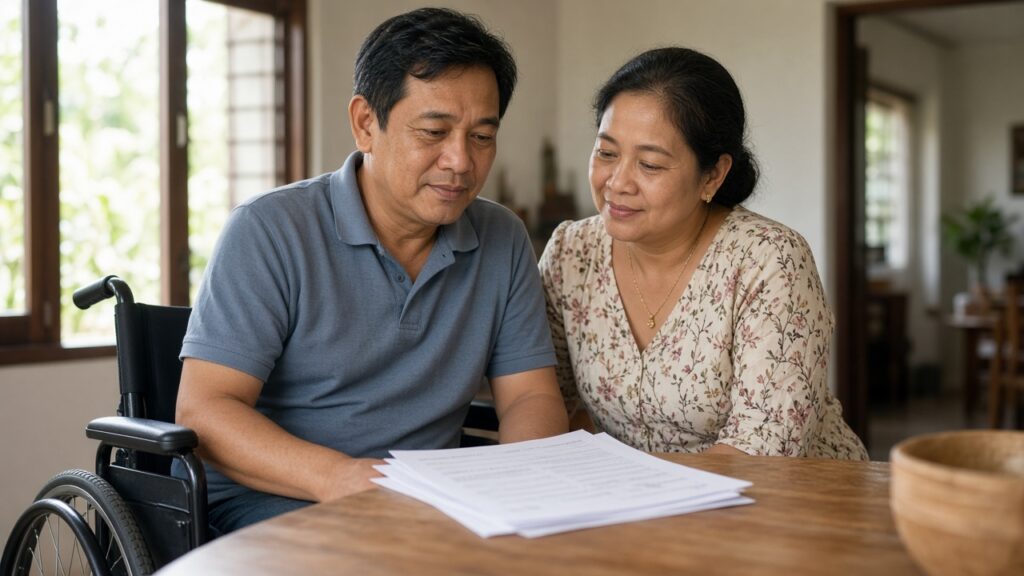
An accident, a stroke, or a serious illness can change a family’s finances overnight, and the bills do not stop. This is exactly the situation the SSS Disability Benefit was made for, yet many members do not know they can claim it, or they assume they have “too few contributions” to get anything.
This guide explains, in plain language, who qualifies for the SSS Disability Benefit, how much you can receive (with sample computations in pesos), what documents to prepare, and how to file. All rules below are based on the official SSS Disability Benefit page.
What is the SSS Disability Benefit?
The SSS Disability Benefit is a cash benefit given either as a monthly pension or a one-time lump sum to a member who becomes permanently disabled, whether totally or partially. SSS uses the World Health Organization’s definition of disability: any restriction or lack of ability, resulting from an impairment, to perform an activity in the manner or range considered normal.
It is different from the SSS Sickness Benefit, which is a daily allowance for days you cannot work because of a temporary illness or injury. The Disability Benefit is for conditions that are permanent.
Who qualifies?
According to SSS, you may qualify if you suffer a permanent partial or permanent total disability and you have at least one (1) monthly contribution paid before the semester of contingency. A “semester” here means two consecutive quarters ending in the quarter when the disability happened. Yes, even one contribution can make you eligible, although the amount will be small.
Permanent total disability
SSS lists these as permanent total disabilities:
- Complete loss of sight of both eyes
- Loss of two limbs at or above the ankles or wrists
- Permanent complete paralysis of two limbs
- Brain injury resulting in incurable mental incapacity
- Other cases determined and approved by SSS
Permanent partial disability
This covers the complete and permanent loss or loss of use of a body part, such as one thumb or finger, one big toe, one hand, arm, foot or leg, one or both ears, hearing in one or both ears, or sight in one eye. SSS also covers the removal of certain female reproductive organs (uterus and/or ovaries), provided the member was below 45 years old at the time of the operation.
Illnesses like stroke, heart disease, cancer, kidney disease, diabetes and some lung conditions are evaluated by the SSS medical specialist based on your medical records. Complete documents matter.
Monthly pension or lump sum?
Which one you get depends mostly on your number of contributions:
- Monthly pension: if you paid at least 36 monthly contributions before the semester of disability.
- Lump sum: if you have fewer than 36 contributions. It is also paid as a lump sum if your disability benefit is assessed as payable for less than 12 months.
How much is the monthly pension?
SSS computes the basic monthly pension using your paid contributions, monthly salary credits and credited years of service (CYS). The same formula is used for the SSS retirement pension, and you get whichever of these is highest:
- ₱300 + (20% × AMSC) + (2% × AMSC × (CYS − 10)); the last part only counts if you have more than 10 credited years
- 40% × AMSC
- The minimum pension: ₱1,000 if you have less than 10 CYS, ₱1,200 with at least 10 CYS, and ₱2,400 with at least 20 CYS
AMSC means Average Monthly Salary Credit. Your salary credit is the bracket used for your SSS contributions (see our SSS contribution guide).
Extra amounts on top of the basic pension
SSS says a disability pensioner also receives:
- a ₱1,000 additional benefit (given since January 2017);
- a ₱500 supplemental disability allowance for total or partial disability pensioners;
- a 13th month pension every December for total disability pensioners (partial disability pensioners get it only if their pension duration is at least 12 months);
- a dependent’s pension for total disability pensioners: 10% of the member’s monthly pension or ₱250, whichever is higher, for each qualified minor child, up to five children starting from the youngest. Children of partial disability pensioners are not entitled to this.
Sample computation
Let’s say Carlo, a factory worker, has 8 credited years and an AMSC of ₱15,000. He suffers a permanent total disability.
- Formula 1: ₱300 + (20% × ₱15,000) = ₱3,300 (no 2% part since he has less than 10 CYS)
- Formula 2: 40% × ₱15,000 = ₱6,000
- Minimum: ₱1,000
His basic pension is the highest, ₱6,000. Adding the ₱1,000 additional benefit and ₱500 supplemental allowance, he could receive around ₱7,500 a month, plus a dependent’s pension for each qualified minor child. This is only an illustration; SSS computes the actual amount from your records. Members with more than 10 credited years also get the extra 2% part, which is why consistent contributions pay off.
How the lump sum is computed
For permanent total disability, the lump sum is the monthly pension multiplied by the number of contributions paid before the semester of contingency, or 12 times the monthly pension, whichever is higher.
For permanent partial disability, it is the monthly pension × number of contributions × percentage of disability, or the monthly pension × 12 × percentage of disability, whichever is higher.
SSS gives this example: a member with a 20% disability and 24 contributions, with a ₱1,000 monthly pension basis:
- ₱1,000 × 24 × 20% = ₱4,800
- ₱1,000 × 12 × 20% = ₱2,400
The member receives the higher amount, ₱4,800.
Documents you need
SSS lists these basic documents:
- Disability Claim Application (DisCA) form, downloadable from the SSS website
- Member’s/Claimant’s Photo and Signature Form (provided by the branch, for initial claims)
- SSS Medical Certificate form filled out by your attending physician within six months before filing
- Certified true copies of supporting medical records
- Your SS card, UMID or another valid ID such as a passport, driver’s license, PhilSys National ID, postal ID or NBI clearance
Some conditions also have waiting periods before you can file. For example, SSS says claims for fractures and strokes are filed four months after the injury, operation or onset, while conditions like diabetes are filed two years after onset, with serial lab results. Check the full table on the SSS page for your specific condition.
How and where to file
- Gather your medical records early. Ask the hospital records section for certified true copies of your abstract, discharge summary, operation record, X-rays, scans or lab results.
- Have your doctor complete the SSS Medical Certificate.
- Enroll a disbursement account in My.SSS. Benefits go to your UMID-ATM card, or through PESONet bank accounts, e-wallets, or accredited remittance and cash payout outlets. Enroll it in the Disbursement Account Enrollment Module with a proof of account, valid ID and a selfie holding both.
- File at any SSS branch. If you are wheelchair-bound, confined in a hospital or institution, or living abroad, a representative may file for you.
- Attend the medical evaluation if the SSS medical specialist asks for one or for more documents.
SSS says payments are credited within five to seven banking days after the claim is settled, and you are notified by email or SMS. You must file within 10 years from the date of disability.
Important rules to remember
- Going back to work can stop the pension. The pension and dependent’s pension are cancelled upon re-employment, resumption of self-employment, or recovery from permanent total disability.
- Do your annual confirmation. Pensions can be suspended if you fail to present yourself under the Annual Confirmation of Pensioners (ACOP) program.
- Your family is protected. If a total disability pensioner dies, the primary beneficiaries receive 100% of the monthly pension (excluding the supplemental allowance).
- Never pay a “fixer”. Filing is free. Only deal with SSS branches, My.SSS, and the official hotline 1455.
Practical money tips if a disability hits your family
- Claim everything you are entitled to. Check if you qualify for a PWD ID and its discounts (see our senior and PWD discount guide), and use PhilHealth for hospital bills and checkups (see PhilHealth YAKAP).
- Rebuild the budget around the new income. A pension of a few thousand pesos will not replace a full salary, so list fixed needs first: food, rent, medicines, utilities.
- Protect your emergency fund. If you still earn, keep building an emergency fund; it is the cushion SSS cannot fully provide.
Bottom line
The SSS Disability Benefit will not make up for everything a disability takes away, but it is a real safety net that many Filipino families leave unclaimed. If you or a family member has a permanent condition and has paid even one SSS contribution, gather the medical records, check the waiting period for the condition, and file at the nearest SSS branch.
This article is general information only and not financial advice. Rates, rules and fees change, so please verify with the provider or the official agency before deciding.