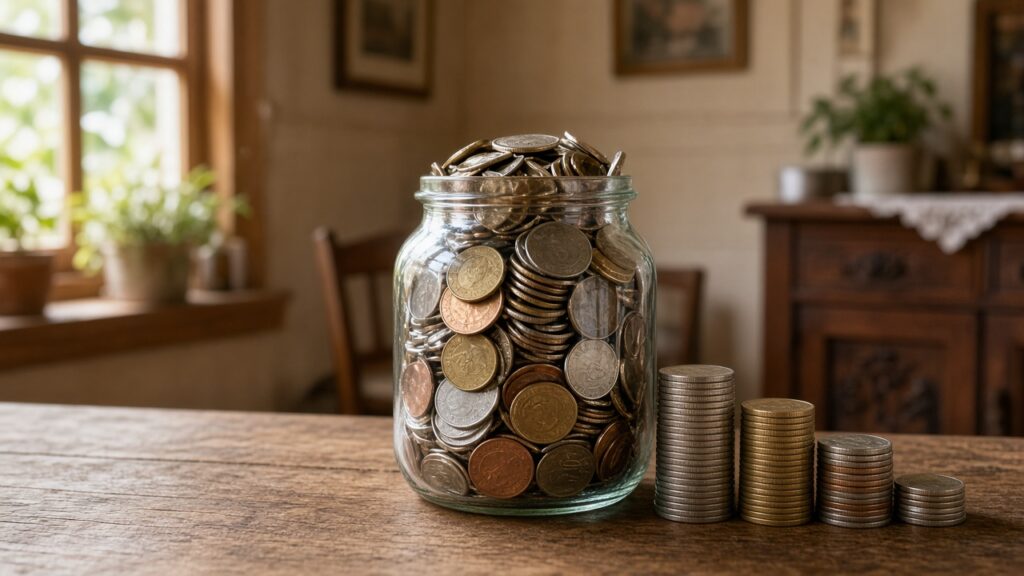
Every Filipino household has one: an alkansya made from a recycled bottle, a tin can, or that classic clay piggy bank that you swore you would never break. By December, it is heavy, it rattles, and you start wondering how much is actually inside and what you can do with it.
Loose coins are real money. But coins sitting in a jar do not earn anything, and they are not much use when you need to pay a bill online. This guide covers the rules on paying with coins, what happened to the BSP coin deposit machines, and practical ways to put your alkansya coins back to work.
First, count and sort your coins
Before you go anywhere, know what you have. Pour everything out on a table and sort by denomination: ₱20, ₱10, ₱5, ₱1, then the sentimo coins (25, 10, 5 and 1 sentimo). Stack them in tens or put them in small labeled plastic bags with the total written on each one.
This helps in three ways:
- You know your exact total, so nobody can shortchange you when you deposit or spend the coins.
- Banks and stores are more willing to accept a big pile of coins when they are already sorted and counted.
- It is a nice reality check. If you saved ₱10 coins all year, you may be surprised how fast they add up.
While sorting, set aside anything that is not current Philippine money: foreign coins, very old or demonetized coins, and badly damaged pieces. Those will not be accepted as regular payment and may need to be handled separately by a bank.
Can you pay with a bag of coins? Yes, up to a limit
Coins issued by the Bangko Sentral ng Pilipinas (BSP) are legal tender, which means they should be accepted as payment. But unlike paper bills, coins have a legal tender limit per transaction.
Under BSP Circular No. 1162, Series of 2022, as reported by BusinessMirror:
- ₱1, ₱5, ₱10 and ₱20 coins should be accepted as payment or change for amounts not exceeding ₱2,000 per transaction.
- 1, 5, 10 and 25 sentimo coins should be accepted for amounts not exceeding ₱200 per transaction.
These limits were doubled from the old ₱1,000 and ₱100 limits. The BSP also said that coins may be used above those limits if both the payer and the person being paid agree.
In practice, this means you can pay a ₱1,500 grocery bill entirely in ₱5 and ₱10 coins, and the cashier should accept it. Just be considerate: bring them sorted and counted, and avoid peak hours when there is a long line behind you.
What happened to the BSP coin deposit machines?
Many Filipinos remember the BSP Coin Deposit Machines (CoDMs), the mall kiosks where you could pour in your coins and credit the amount to an e-wallet or convert it to a shopping voucher. According to BusinessWorld, the BSP first deployed the machines in June 2023 in select malls in the Greater Manila Area, then suspended them in June 2025 to address operational issues. As of mid-March 2025, the machines had collected nearly 340 million coins worth about ₱1.373 billion.
Here is the current status, based on recent reports:
- The BSP partnered with SM for the relaunch. SM will take on coin retrieval and verification, and dedicated personnel will attend to machine problems, according to The Philippine Star.
- The plan is 50 machines: 25 returning in Metro Manila and 25 more in other areas such as Pampanga, Baguio, Cebu and Davao.
- On October 30, 2026, BSP Deputy Governor Bernadette Romulo-Puyat told Rappler that the central bank is now eyeing January 2027 for the machines’ return, with Cebu likely getting the first regional launch. She said the delay was mainly because the service provider was taking longer than expected.
So if you were saving your coins for the machines, you may have to wait a little longer. Dates can still move, so watch for an official announcement from the BSP before you lug a heavy jar to the mall.
How the machines worked before (and may work again)
Under the earlier setup, the Maya help page described the process this way: you put your coins in the slot, the machine counts them, you choose your e-wallet, and you enter a cash-in code generated in the app. Maya said cashing in through the machines was free. The BSP’s earlier CoDM FAQ also said no ID was needed, though you had to key in your e-wallet account number.
The relaunched machines may have different partners, options or rules, so treat these details as background, not a guarantee of how the new machines will work.
Five practical things to do with your coins now
1. Deposit them in your bank account
The simplest option is to bring your sorted coins to your bank branch and deposit them into your own savings account. Policies vary by bank and branch. Some may ask you to pre-sort or count the coins, or to come at a less busy time. Call or ask your branch first so you do not waste a trip.
2. Ask about coin exchange programs
While the coin machines were suspended, the GCash Help Center pointed users to exchange coins at banks or currency exchange centers under the BSP’s Piso Caravan program. Check the BSP’s official website and social media pages for current schedules and locations near you.
3. Use them for everyday cash expenses
Coins are perfect for things you pay in cash anyway: jeepney and tricycle fares, the sari-sari store, the palengke, parking, and small purchases. Put a small pouch of coins in your bag each day. This slowly empties your alkansya without any trips to the bank.
Small business owners in your area may also welcome coins, since vendors and sari-sari stores often need loose change. Offering to swap your coins for their bills can be a win for both of you.
4. Move the money where it can grow
Once your coins become bills or a bank balance, give that money a job. A few options already covered on MoneySense:
- Add it to your emergency fund.
- Put it in a digital savings account that earns interest.
- Use it as a starter for a sinking fund for school fees, insurance or your Christmas budget next year.
- If you are a Pag-IBIG member, consider adding it to your MP2 savings.
5. Keep the alkansya habit, with a target
The alkansya is still a great habit, especially for kids. Make it more useful by giving it a goal and a date, for example “₱20 coins only, opened every December for gifts.” When you break it open, deposit the money right away instead of letting it drift back into random spending.
What NOT to do with coins
Some people melt coins, drill holes in them for crafts, or flatten them for souvenirs. That can get you in serious trouble. Under Presidential Decree No. 247, it is unlawful to willfully deface, mutilate, tear, burn or destroy currency notes and coins. Violators face a fine of not more than ₱20,000 and/or imprisonment of not more than five years, as stated in this BSP financial literacy material. In February 2026, the BSP also reminded the public that melting and damaging coins is punishable under this law, according to Manila Standard.
A few other reminders:
- Do not let coins sit idle for years. The BSP has said its coin deposit program aims to address the artificial coin shortage in certain areas by bringing idle coins back into circulation.
- Be wary of anyone offering to “buy” your coins above face value or asking you to pay fees upfront to convert them. Stick to banks, official BSP programs and your e-wallet’s official channels.
- Do not throw away old or damaged coins. Ask your bank how to have them assessed instead.
Quick checklist
- Sort and count your coins by denomination.
- Set aside foreign, demonetized or damaged coins.
- Remember the per-transaction limits: up to ₱2,000 for peso coins and ₱200 for sentimo coins, unless both sides agree to more.
- Deposit at your bank or check BSP coin exchange programs like Piso Caravan.
- Watch for the official BSP announcement on the coin deposit machines’ return, currently eyed for January 2027.
- Move the money into savings, an emergency fund or MP2.
- Never melt, drill or deface coins.
Your alkansya is proof that small amounts add up. Turning those coins into savings that are safe, counted and working for you is the final, satisfying step.
This article is general information only and not financial advice. Rates, rules and fees change, so please verify with the provider or the official agency before deciding.