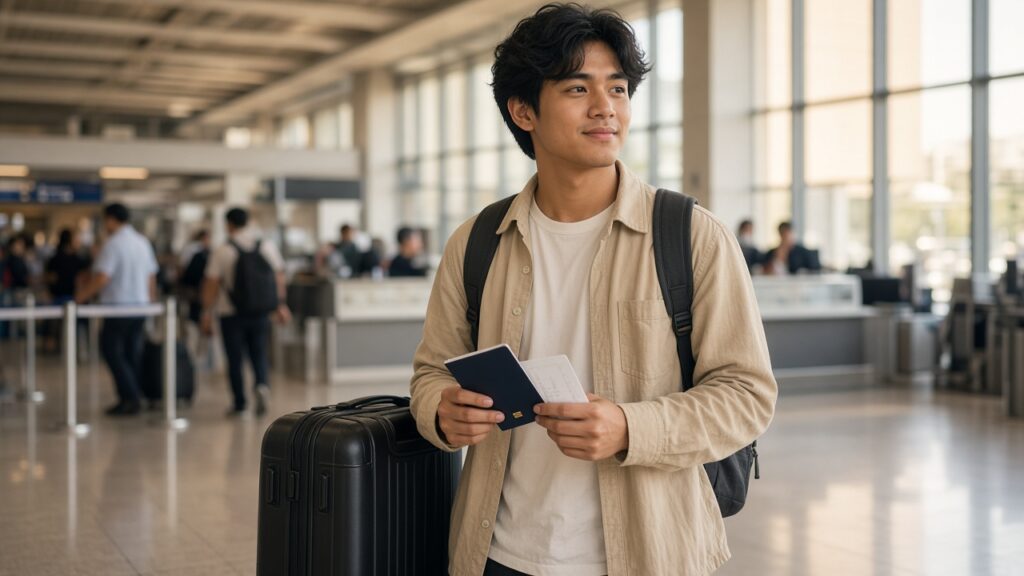
Planning a Christmas trip to Japan, a Holy Week getaway in Bangkok, or a visit to family abroad? Before you count your pocket money, there is one government charge many first-time travelers forget: the Philippine travel tax. At ₱1,620 per person in economy class, a family of four can easily spend more than ₱6,000 on it alone. The good news is that some travelers pay less, some pay nothing, and some who already paid can get their money back.
This guide explains how much the travel tax is in 2026, who must pay, who is exempt or gets a reduced rate, how to pay it, and how to claim a refund. All figures below come from the official website and Citizen’s Charter of the Tourism Infrastructure and Enterprise Zone Authority (TIEZA), the agency that collects it.
What is the travel tax?
According to TIEZA’s travel tax page, the travel tax is a levy imposed by the government on individuals leaving the Philippines, no matter where the plane ticket was issued or how it was paid, as provided for by Presidential Decree 1183, as amended. Under the Tourism Act (RA 9593), 50% of collections go to TIEZA, 40% to the Commission on Higher Education (CHED) for tourism-related education programs, and 10% to the National Commission for Culture and the Arts (NCCA).
It is different from the airport terminal fee, which is a separate charge. The travel tax applies only when you leave the country, not on domestic flights.
How much is the travel tax in 2026?
TIEZA lists three rates:
| Rate | First class | Economy class |
|---|---|---|
| Full travel tax | ₱2,700 | ₱1,620 |
| Standard reduced travel tax | ₱1,350 | ₱810 |
| Privileged reduced travel tax (dependents of OFWs) | ₱400 | ₱300 |
Source: TIEZA – Travel Tax and TIEZA – Reduced Travel Tax.
One small extra: TIEZA’s Travel Tax Citizen’s Charter (3rd Edition, 2026) says paying at its counters by credit card or e-wallet adds a 1.266% convenience fee. That makes the full rate ₱1,640.51 for economy and ₱2,734.18 for first class. This fee goes to the private payment gateway, not to TIEZA. If you want to pay the exact round amount at a counter, bring cash.
Who must pay the full travel tax?
Based on TIEZA’s full travel tax page, these travelers pay the full rate:
- Citizens of the Philippines
- Permanent resident aliens and other taxable foreign passport holders
- Non-immigrant foreign passport holders who have stayed in the Philippines for more than one year
Who pays a reduced rate?
The standard reduced rate (₱810 economy, ₱1,350 first class) applies to:
- Children from 2 years and one day old up to their 12th birthday on the date of travel
- Accredited Filipino journalists traveling for a journalistic assignment, with the required certifications
- Those authorized by the President for reasons of national interest
The privileged reduced rate (₱300 economy, ₱400 first class) is for dependents of an OFW who are traveling to the OFW’s worksite:
- The legitimate spouse of the OFW
- Unmarried children of the OFW, legitimate or illegitimate, below 21 years old
- Children of OFWs with disabilities, even if above 21 (with a PWD ID issued by NCDA-established offices)
The usual documents include the original passport, the OFW’s Overseas Employment Certificate (OEC) or certified Balik-Manggagawa form, and a marriage or birth certificate. For a family visiting an OFW parent in, say, Dubai, the difference is real: an 8-year-old pays ₱810 under the standard reduced rate, but as an OFW’s dependent going to the worksite, the same child would pay only ₱300.
Who is exempt?
The TIEZA exemption page lists the main exempt Filipino travelers under Sec. 2 of PD 1183:
- Overseas Filipino workers. The OEC is valid as an exemption certificate when going to the OFW’s worksite. Directly hired OFWs need a certificate of employment or contract authenticated by the Philippine Embassy or Consulate.
- Filipino permanent residents abroad whose stay in the Philippines is less than one year. TIEZA notes that first-time immigrants do not yet qualify.
- Infants 2 years old and below. The date of travel must not be beyond the infant’s 2nd birthday.
The full list also covers balikbayans who have been continuously out of the country for at least one year, airline crew on international routes, scholars with government-approved scholarships of more than one year, government officials and employees on official business (excluding GOCCs), Muslim Filipinos joining the annual pilgrimage to Mecca with an NCMF endorsement, and several other groups. Each one has its own documentary requirements, so check the table on TIEZA’s page before you go.
If you qualify, you get a Travel Tax Exemption Certificate (TEC). According to the Citizen’s Charter, there is no fee for processing it. You can apply online, but TIEZA says your flight must be at least one day after your online application, and online applications are processed within one day of submitting complete documents. If your flight is sooner, you need to apply on-site at a TIEZA office or airport counter.
How to pay the travel tax
There are three common ways:
- Included in your plane ticket. Many airlines collect it when you book. Check your fare breakdown or e-ticket before paying again. Paying twice is a common and avoidable mistake.
- Online through TIEZA. Use the Online Travel Tax Services System (OTTSS) for payment, exemption, reduced rate and refund services. Always go through the link on tieza.gov.ph instead of a link from a text message or social media post, to avoid fake payment sites.
- At a TIEZA counter at the airport or a TIEZA Travel Tax Office, using your original passport and airline ticket.
Keep your official receipt or e-receipt until after your trip. You will need it if you later claim a refund.
Already paid but shouldn’t have? Get a refund
Based on the TIEZA Citizen’s Charter, you may apply for a refund if you have:
- An unused ticket (with a fare refund voucher, or an airline certification that the ticket is unused, non-rebookable and has no fare refund value)
- A downgraded ticket, for example from first class to economy
- A double payment for the same ticket
- An undue collection, or you were actually qualified for exemption or a reduced rate
Important rules from the charter: claims must be made within two years from the date of travel tax payment, and valid refunds are paid by check to the person named on the ticket. TIEZA’s reduced rate page also says that travelers who paid the full rate but qualify for the reduced rate can apply for a refund of the excess on-site at any TIEZA Travel Tax Office or airport counter.
Practical tip: if your trip was cancelled and the airline refunded only part of your ticket, check whether the travel tax portion came back too. If it did not, that ₱1,620 per person may still be claimable from TIEZA.
Is the travel tax being abolished?
Not yet. The House of Representatives approved House Bill 8464, which would abolish the travel tax, on March 16, 2026, but the Senate has not passed its version as of mid-November, as noted in The Philippine Star. During a September Senate budget hearing, TIEZA asked lawmakers for a transition period before any abolition because most of its operations depend on travel tax collections, the Inquirer reported.
Until a law is actually signed and takes effect, the current rates apply. Do not skip budgeting for it based on news that it “might” be removed.
How to budget for it
- Add it to your trip budget from the start. A couple flying economy needs ₱3,240; a family of two adults and two kids aged 5 and 9 needs ₱3,240 + ₱1,620 = ₱4,860.
- Check the fare breakdown when comparing seat sales. A cheap promo fare may not include the travel tax, so the real cost is higher.
- Apply early for exemptions or reduced rates. Since online applications need at least one day before your flight, do it once your ticket is booked, not on the way to the airport.
- Put the amount in a travel sinking fund together with the terminal fee, baggage and pocket money, so it does not end up on your credit card.
Key takeaways
- The full travel tax is ₱1,620 for economy and ₱2,700 for first class.
- Kids aged above 2 up to 12 pay ₱810 in economy; OFW dependents going to the worksite pay ₱300.
- OFWs, qualified permanent residents abroad and infants 2 and below are exempt, and the TEC is free.
- Refunds are possible for unused tickets, double payments and wrong charges, but file within two years of payment.
- The abolition bill is still pending in the Senate, so budget for the tax for now.
This article is general information only and not financial advice. Rates, rules and fees change, so please verify with the provider or the official agency before deciding.