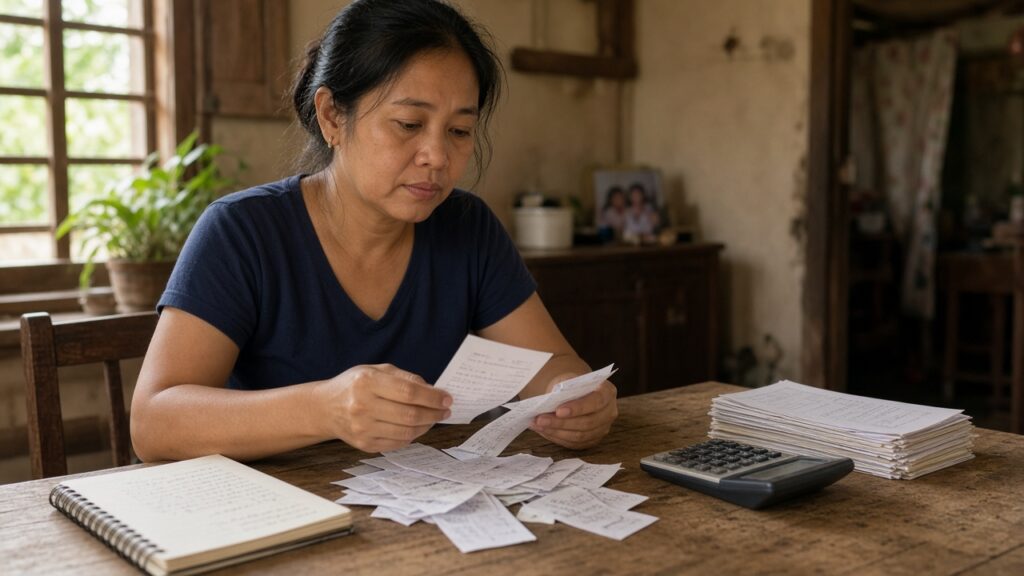
May pinautang ka sa kaibigan, kamag-anak o dating kasosyo, tapos puro “next week na lang” ang sagot? Or you rented out a room, delivered a service, or sold something on installment, and the payments just stopped. Many Filipinos simply let it go because they think going to court means hiring a lawyer and spending more than the amount owed.
For many unpaid debts, that is not true. The Philippines has a small claims process designed for ordinary people. It is fast, uses simple fill-in-the-blank forms, and lawyers are not allowed to appear for the parties at the hearing. This guide explains how it works, what you need to prepare, and the honest limits you should know before filing.
What is a small claims case?
A small claims case is a purely civil case where you are asking only for the payment or reimbursement of a sum of money. It is filed in first-level courts: the Metropolitan Trial Courts, Municipal Trial Courts in Cities, Municipal Trial Courts and Municipal Circuit Trial Courts.
Under the Rules on Expedited Procedures in the First Level Courts (A.M. No. 08-8-7-SC), approved by the Supreme Court in March 2022 and effective April 11, 2022, the small claims limit is ₱1,000,000, exclusive of interest and costs. The same limit applies whether you file inside or outside Metro Manila.
According to the Supreme Court, the claim may be for money owed under:
- Contracts of loan and other credit accommodations (personal utang, unpaid advances)
- Contracts of lease (unpaid rent)
- Contracts of services (you did the work but were not paid)
- Contracts of sale of personal property (you sold an item, gadget or goods and were not fully paid)
It also covers enforcing a barangay amicable settlement or arbitration award where the money claim does not exceed ₱1,000,000. What it does not cover: getting back a specific item (recovery of personal property, unless part of a compromise), cases involving land titles, and claims that ask for something other than money.
Why small claims can make sense for everyday Filipinos
- No lawyers at the hearing. You speak for yourself, and so does the other side. Lawyers can still advise you outside the courtroom, but they cannot appear as counsel unless they are the party themselves.
- Simple forms. The Office of the Court Administrator publishes the official small claims forms, including English/Tagalog and English/Bisaya versions.
- One hearing day. The Supreme Court says there is only one hearing day, and judgment is rendered within 24 hours after the hearing ends.
- Fast timelines. The hearing date should be set not more than 30 calendar days from filing, or not more than 60 days if a defendant lives or does business outside the court’s judicial region.
- Final decision. The decision in a small claims case is final, executory and unappealable, so there is no long appeal process.
Step 1: Try to settle first and send a demand letter
Before going to court, give the other person a fair chance to pay. Send a clear written demand stating the amount owed, the basis (e.g., “loan of ₱25,000 on March 5, 2026”), and a reasonable deadline. Keep a copy and proof that it was received, like a courier receipt, registry return card, or a screenshot of the message showing it was seen.
Step 2: Check if barangay conciliation is required
Under the Katarungang Pambarangay provisions of the Local Government Code (RA 7160), many disputes between individuals who actually live in the same city or municipality must go through the barangay first. If no settlement is reached, the barangay issues a Certification to File Action, which you attach to your claim.
Barangay conciliation is generally not required when, for example, one party is a corporation or other juridical entity, or the parties live in different cities or municipalities that are not covered. Skipping it when it is required is a common reason claims get dismissed, so ask your barangay hall or the court’s Clerk of Court if you are unsure.
Tip: lawyers cannot appear for parties in barangay conciliation either (Sec. 415, RA 7160). You attend in person. A written settlement reached at the barangay can be enforced like a final judgment.
Step 3: Gather your evidence
This is the most important part. In small claims, the evidence you submit with your Statement of Claim is generally what the court will look at. Evidence not attached is usually not allowed at the hearing unless good cause is shown. Prepare copies of:
- The contract, promissory note, IOU or acknowledgment receipt, if any
- Proof the money was actually given, such as bank transfer records, e-wallet receipts, or deposit slips
- Chats, texts or emails where the other person admits the debt or promises to pay
- Your demand letter and proof of receipt
- Barangay Certification to File Action, if required
- Affidavits of witnesses, if any
- Valid ID
Step 4: Fill out the Statement of Claim and file it
Download Form 1-SCC (Statement of Claim) from the OCA website or get a copy from the court. Fill it out completely, have it verified, attach your evidence, and file it with the Office of the Clerk of Court of the proper first-level court. Court personnel are tasked to assist with the forms, so do not be shy to ask.
If you are an OFW or cannot attend in person for a valid reason, the rules allow a representative who is not a lawyer, authorized through a Special Power of Attorney using Form 7-SCC.
Step 5: Pay the filing fees
Filing fees follow Rule 141 of the Rules of Court and depend on the amount of your claim. Because fee schedules can be updated, ask the Clerk of Court for the exact assessment when you file. If you cannot afford the fees, you may ask to litigate as an indigent using Form 6-SCC.
Under OCA Circular No. 79A-2022, a party who files more than five small claims in one calendar year pays an additional ₱500 per claim after the fifth, increasing progressively after the tenth and fifteenth claims.
Step 6: Summons, response and the hearing
If the court finds no ground to dismiss your claim, it issues the Summons and Notice of Hearing. The defendant then has a non-extendible 10 calendar days from receipt of the summons to file a verified Response with their own evidence.
On the hearing day, the judge first tries to help both sides reach a settlement. Many cases end here with a compromise, such as a payment plan. If there is no settlement, the judge hears both sides informally and decides within 24 hours after the hearing.
Be on time and bring originals of your documents. Unjustified postponements are not allowed, and failing to appear without valid reason can lead to dismissal of your claim.
Step 7: If you win, collecting is a separate step
Winning does not automatically put cash in your hand. If the other side does not pay voluntarily, you file a Motion for Execution (Form 12-SCC), and the court can issue a writ of execution so the sheriff can enforce the judgment against the debtor’s non-exempt assets, like bank deposits or property.
Be realistic: if the person truly has no income or assets, collection can still be difficult even with a favorable decision. That is why settlement and a written payment plan are often the most practical outcome.
What about interest?
If your written agreement states an interest rate, the court will look at that, though courts can reduce rates that are unconscionable. If there was no agreed interest, the Supreme Court in Nacar v. Gallery Frames (G.R. No. 189871, 2013) applied a legal interest rate of 6% per year from the time of demand, in line with BSP Monetary Board Circular No. 799. This is one more reason to keep proof of your demand letter.
Don’t wait too long
Claims have deadlines called prescriptive periods. Under the Civil Code, actions on a written contract generally prescribe in 10 years (Art. 1144), while actions on an oral contract generally prescribe in 6 years (Art. 1145). Do not let a valid claim expire because of hiya or delay.
Common mistakes to avoid
- Splitting a big claim into smaller cases to stay under the limit. This is not allowed.
- Skipping the barangay when conciliation is required.
- Incomplete evidence. Attach everything when you file.
- Bringing a lawyer to speak for you at the hearing. Consult them beforehand instead.
- Shaming the debtor online. It can expose you to legal liability.
Bottom line
Small claims court is one of the most practical tools for recovering unpaid loans, rent, service fees or sales of up to ₱1,000,000 without a lawyer. Start with a polite but firm demand, go through the barangay if required, organize your proof, and use the official forms. And next time someone asks “Pautang naman,” put it in writing.
This article is general information only and not financial advice. Rates, rules and fees change, so please verify with the provider or the official agency before deciding.