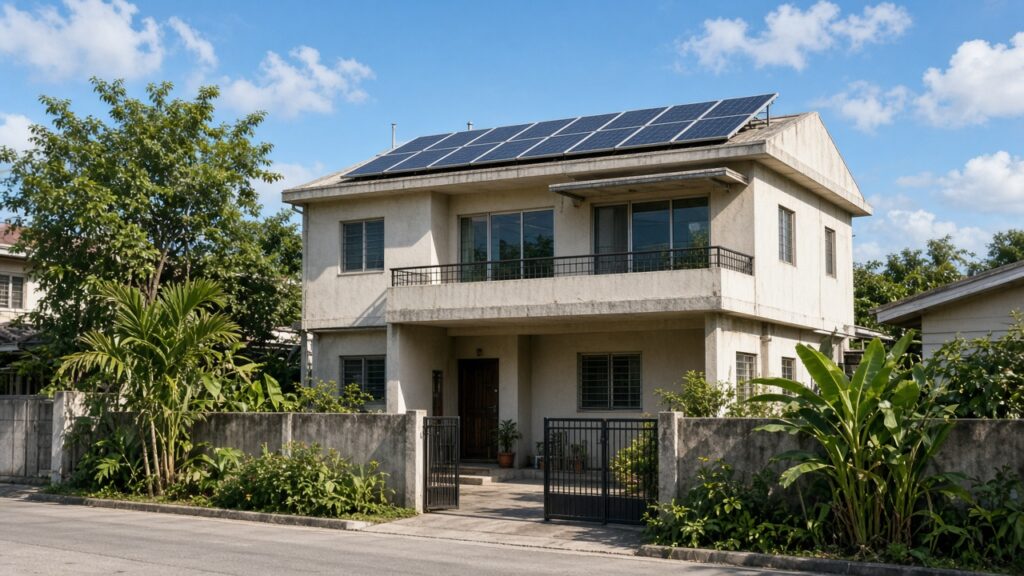
Kung tumataas ang Meralco bill mo buwan-buwan, hindi ka nag-iisa, kaya maraming pamilya ang nagtatanong tungkol sa rooftop solar at net metering. For November 2026, Meralco’s overall rate for a typical household went up to ₱15.5510 per kWh, from ₱15.0615 in October, or about ₱98 more for a home using 200 kWh (Meralco).
This guide explains how net metering works in the Philippines, who can apply, what it costs to sign up, how much you actually get for the power you send back to the grid, and the honest questions to ask before you spend on solar panels.
What Is Net Metering?
Net metering is a billing arrangement between you and your distribution utility (Meralco, VECO or your electric cooperative). You install your own renewable energy system, usually solar panels, and use the electricity at home. When your panels produce more than your house is using, the extra power is automatically exported to the utility’s lines. The utility then gives you a peso credit for that exported energy, which is deducted from your electric bill.
Under the Energy Regulatory Commission (ERC) rules, net metering covers on-site renewable energy systems of up to 100 kilowatts (kW) (GMA News).
To track this, the utility installs a bi-directional meter that records electricity flowing both ways: what you import from the grid and what you export to it (Meralco Net Metering FAQ).
The Most Important Detail: Exported Power Is Worth Less
This is the part many people miss. A kilowatt-hour you use at home and a kilowatt-hour you export are not worth the same.
- Solar power you use right away replaces electricity you would have bought at the full retail rate, which includes generation, transmission, distribution, taxes and other charges.
- Solar power you export is credited only at the utility’s blended generation cost, excluding other generation adjustments. This is the standard rate under the ERC’s 2025 Amended Net-Metering Rules (Ocampo & Suralvo via Lexology).
Here is how that looked in real numbers for November 2026. Meralco’s generation charge table lists “Export Energy from Net Metering Customers” at ₱10.1297 per kWh (Meralco November 2026 Generation Charge Table), while the overall residential rate was ₱15.5510 per kWh.
| What happens to 1 kWh from your panels | Approximate value (Meralco, Nov 2026) |
|---|---|
| You use it at home (avoided purchase) | About ₱15.55 |
| You export it to the grid (bill credit) | About ₱10.13 |
Both figures change every month. The lesson stays the same: solar saves the most when you use the power yourself during the day. Run heavy appliances while the sun is up.
What Changed in the 2025 ERC Rules
On August 27, 2025, the ERC issued Resolution No. 15, Series of 2025, amending the net-metering rules (GMA News). Key changes for households:
- Credits roll over. Net-metering credits can now be banked and applied to your bill in the current and future billing periods. So credits earned during sunny summer months can still help during the rainy season.
- Credits can follow the house. If the property changes owners, the credits may be transferred to the new owner, subject to conditions such as a conforme letter from the original owner.
- REC meter is optional. The separate Renewable Energy Certificate (REC) meter, which measures how much your system generates, is now voluntary. If you skip it, generation is estimated using an ERC formula, and you submit an affidavit and waiver.
Faster Approval in 2026
In April 2026, the Department of Energy (DOE) ordered distribution utilities and electric cooperatives to complete the processing of net-metering applications within a non-extendible 10 working days, down from 20. Local government units must act on related permits within 3 working days. The directive includes a “no additional requirements” policy and a “deemed approved” provision if no action is taken within the timeline (GMA News).
Take note: the DOE said these shorter timelines apply for the duration of the national energy emergency declared under Executive Order No. 110, s. 2026. Once that ends, the timelines may change, so check with your utility.
Who Can Apply (Meralco Example)
According to Meralco, you may apply for net metering if (Meralco):
- Your renewable energy system is up to 100 kW (100 kWp for solar PV)
- Your Meralco account is registered under the same name as the applicant
- Your account is in good credit standing, with no unpaid bills or outstanding balance when you apply
Renting? Since the account must be in the applicant’s name, you will usually need the owner and account holder involved. Talk to your landlord before buying any panels.
If you are not under Meralco, ask your electric cooperative or local utility for its own net-metering requirements. The ERC rules cover distribution utilities in general, but forms and steps can differ.
Requirements and Fees
Meralco lists these basic requirements:
- Accomplished net-metering application form
- Certificate of Final Electrical Inspection (CFEI) from your LGU
- Signed Net-Metering Agreement
- ERC Certificate of Compliance (COC) application fee of ₱1,500
Depending on your setup, Meralco may also require a notarized affidavit and waiver if you choose not to install a REC meter, and a Difference in Meter Cost (DIMC) fee if your current meter cannot read imports and exports and must be replaced with a bi-directional one. Following an ERC advisory dated September 22, 2025, Meralco says this amount shall not exceed ₱3,000 for residential customers (Meralco).
Do You Even Need Net Metering?
Not always. Meralco says that if you only want to use solar for your own consumption and will not export, you do not need net metering. You may sign up for Zero Export instead, but you should still inform Meralco for electrical safety and stable service in your area (Meralco).
Zero Export can make sense if your daytime usage is high enough to consume most of what your panels produce. Net metering makes more sense if your home is often empty during the day, since the excess would otherwise go to waste.
Is Rooftop Solar Worth It for Your Family?
Solar is a big purchase, often paid upfront or through a loan. Before signing anything, do your own math instead of relying on a sales pitch.
1. Know your daytime usage
Look at your last 12 bills for your monthly kWh. If most of your consumption is aircon at night, daytime solar alone will not cover it unless you add batteries, which add a lot to the cost.
2. Get at least three written quotes
Ask each installer for the system size in kWp, estimated monthly production in kWh, brand and warranty of panels and inverter, inclusions (mounting, wiring, permits, net-metering processing), and after-sales service.
3. Compute a simple payback
Use this rough formula:
Monthly savings ≈ (kWh you use directly × your retail rate) + (kWh you export × the export credit rate)
Payback in years ≈ Total system cost ÷ (Monthly savings × 12)
Use the current rates on your own bill. Remember that rates move every month, panels produce less on cloudy and rainy days, and equipment like inverters may need repair or replacement within the life of the system.
4. Avoid financing that eats your savings
If you will borrow to buy solar, compare the monthly amortization against your realistic monthly savings. If the loan payment is bigger than the savings, you are adding to your monthly expenses, not reducing them. Ask for the effective interest rate, not just the “add-on” rate.
5. Watch out for red flags
- “Zero bill guaranteed” promises. You will still pay for electricity you import at night and on cloudy days.
- Pressure to pay in full immediately, or deals with no written contract
- Installers who refuse to handle or explain permits and the net-metering process
- Quotes that do not name the equipment brands or warranty terms
Cheaper Steps to Try First
If solar is not in your budget yet, you can still cut your bill. Replace old appliances with efficient ones using the DOE energy label, unplug idle devices, and set your aircon at a moderate temperature. Our guides on reading the DOE energy label and lowering your Meralco bill can help. Low-income households may also check if they qualify for the lifeline rate.
Bottom Line
Net metering lets you earn bill credits for extra solar power, and the 2025 ERC rules plus the 2026 DOE directive have made it easier to apply. But exported power is credited at a lower rate than what you pay for grid electricity, so the best savings come from using your solar power during the day. Get several quotes, do the payback math with your own bills, and only push through if the numbers work for your family.
This article is general information only and not financial advice. Rates, rules and fees change, so please verify with the provider or the official agency before deciding.