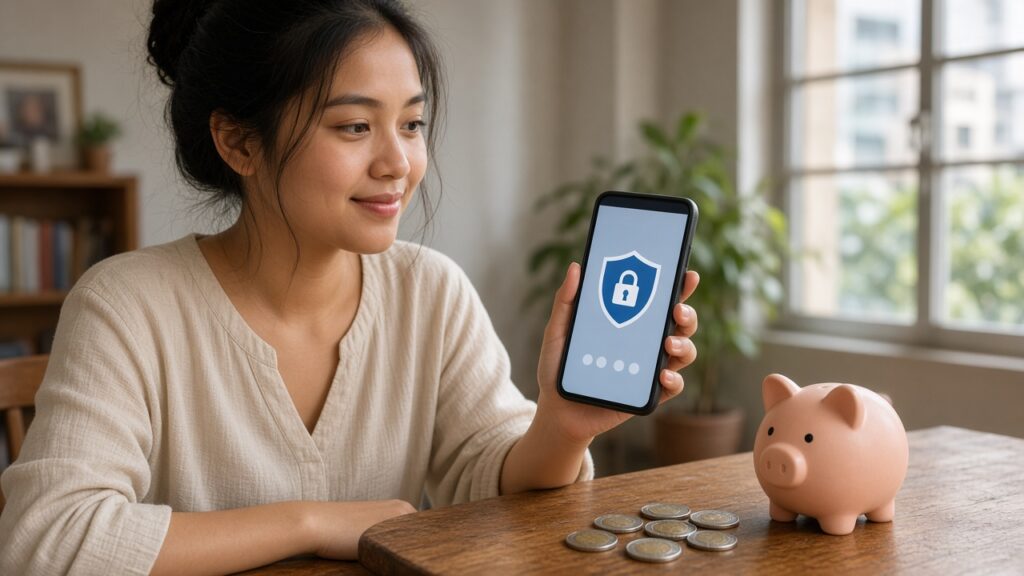
Digital banks have changed how many Filipinos save. You can open an account on your phone in minutes, skip the long bank lines, and often see interest rates that look much higher than a traditional savings account. But a common worry keeps coming up: is my money actually safe in a bank that has no branches?
The short answer is that a real, licensed digital bank is a bank in every legal sense, and your deposits there are protected by the Philippine Deposit Insurance Corporation (PDIC) the same way they are in a big traditional bank. The longer answer has a few important limits that every saver should know, especially the difference between a bank account and an e-wallet, and what deposit insurance does not cover.
What exactly is a digital bank?
A digital bank is a bank licensed by the Bangko Sentral ng Pilipinas (BSP) that serves customers mainly through an app or website instead of physical branches. It can accept deposits, lend money and offer payments, just like other banks. The difference is the channel, not the legal status.
According to the BSP and news reports in mid-2026, there are six licensed digital banks in the country: GoTyme Bank, Maya Bank, Overseas Filipino Bank (a digital bank of LANDBANK), Tonik Digital Bank, UnionDigital Bank and UNObank (BSP list, as of 30 June 2026; Philstar). The BSP lifted its moratorium on new digital bank licenses in January 2025 and allows up to 10, so more names may be added. Always check the latest list yourself rather than relying on an app’s advertising.
Yes, digital bank deposits are PDIC-insured
The BSP requires all licensed banks to be members of the PDIC, and that includes digital banks. The PDIC publishes its own directory of insured digital banks.
Effective March 15, 2025, the PDIC doubled its maximum deposit insurance coverage from ₱500,000 to ₱1 million per depositor, per bank (PDIC). You do not pay for this insurance. Member banks pay premiums into the fund.
Two phrases in that rule matter a lot:
- Per depositor. All your accounts at the same bank, held in the same right and capacity, are added together. If you have ₱700,000 in savings and ₱500,000 in a time deposit at one bank, that is ₱1.2 million total, and only up to ₱1 million is insured (PDIC FAQ).
- Per bank. Coverage is counted separately for each bank. Spreading savings across different banks can keep each balance within the insured limit.
What PDIC insurance covers
According to the PDIC, insured deposit types include:
- Savings and special savings accounts
- Demand or checking accounts
- Negotiable Orders of Withdrawal (NOW) accounts
- Long-term negotiable certificates of deposit
- Time deposits
- Islamic deposits
- Foreign currency deposits
So the savings account, “vaults,” “stashes,” goal-based savings or time deposits inside a digital bank app are generally covered, as long as they are deposit products of the bank itself. If you are unsure whether a feature is a deposit or something else, ask the bank directly.
What PDIC insurance does NOT cover
This is where many people get surprised. Deposit insurance is a safety net for when a bank is closed. It is not a guarantee against every kind of loss.
- E-wallet balances. Money sitting in an e-wallet like GCash or the Maya wallet is not considered a bank deposit, so it is not PDIC-insured (Rappler explainer citing PDIC). Savings products offered inside those apps by a partner bank, such as GSave or Maya Bank savings, are a different story because the money is deposited with a bank. Check which bank holds it.
- Investment products. Bonds, stocks, mutual funds, UITFs, trust accounts and crypto are not deposits, even if you buy them through a banking app.
- Scams and hacking. PDIC officials have said deposit insurance does not cover money lost to scams, phishing or account takeovers. That kind of problem has to be resolved with your bank and the authorities.
- Non-banks. Deposits in cooperatives and non-stock savings and loan associations are not covered by PDIC.
- Fictitious or fraudulent accounts, and deposits found to be proceeds of illegal activity.
So which is riskier for most people: bank failure or scams?
For most ordinary savers, the bigger day-to-day risk is not a bank closing. It is someone tricking you into giving away your one-time PIN, logging in through a fake link, or “investing” in something that is not a real deposit. Insurance cannot protect you from those, so your own habits matter more than any bank’s ads.
A few practical habits:
- Download banking apps only from the official app store listing linked from the bank’s real website.
- Never share your OTP, MPIN or password, even with someone claiming to be from the bank. Real banks do not ask for these.
- Do not click links in texts or emails that say your account is locked or you won a prize. Open the app directly instead.
- Turn on transaction alerts and biometric login, and set transfer limits if your app allows it.
- Report fraud right away to your bank’s official hotline. If the bank does not resolve your complaint, you can escalate to the BSP’s consumer assistance channels listed on bsp.gov.ph.
How to check if a “digital bank” is real
Scammers sometimes copy the look of real banks or invent “bank-like” apps promising very high, fixed returns. Before you deposit:
- Look for the name on the BSP and PDIC lists. If it is not a licensed bank, it is not a bank, no matter what the app says.
- Look for the PDIC insurance statement on the bank’s official website and app. Member banks are expected to display it.
- Be suspicious of “guaranteed” double-digit returns, referral bonuses that depend on recruiting others, or pressure to deposit quickly. Those are red flags of investment scams, not features of a licensed savings account.
- Read what you are actually buying. A “high-yield” product that turns out to be an investment or a lending scheme is not covered by deposit insurance.
Smart ways to use digital banks as a Filipino saver
- Use them for your emergency fund or short-term goals. Easy access and PDIC coverage make a licensed digital bank a reasonable place for money you might need soon.
- Compare the real rate, not the headline. Promo rates can be limited by balance caps, time periods or conditions. Interest is also subject to tax, so the amount you take home is lower than the advertised rate. Read the bank’s own product terms.
- Keep each bank’s total under ₱1 million if you want all of it insured. If your savings grow past that, consider splitting them across different licensed banks.
- Do not leave big savings in your e-wallet. Use the wallet for spending and transfer savings into an insured bank account.
- Keep a traditional bank too. Some transactions, like large loans or certain government payments, can still be easier with a bank that has branches.
The bottom line
Licensed digital banks in the Philippines are real banks, and deposits in them are insured by the PDIC up to ₱1 million per depositor, per bank, the same as traditional banks. That protection kicks in if a bank is closed. It does not cover e-wallet balances, investments, cooperatives, or money lost to scams and hacking. Stick to banks on the official BSP and PDIC lists, understand what product you are putting money into, and guard your login details. Do those three things and a digital bank can be a convenient, sensible home for your savings.
This article is general information only and not financial advice. Rates, rules and fees change, so please verify with the provider or the official agency before deciding.