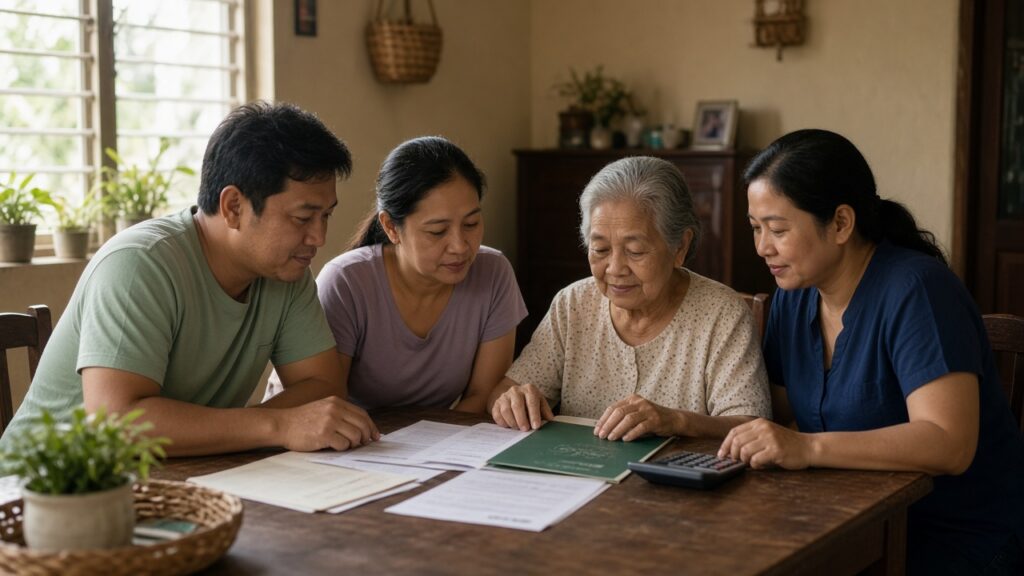
When a parent or loved one passes away, the last thing anyone wants to think about is the BIR. But in many Filipino families, the land title stays in Lolo’s name for decades, the bank account of Nanay gets frozen, and nobody can sell or transfer anything because the estate tax was never settled. Years later, the penalties are bigger than the tax itself.
This guide explains how estate tax works in the Philippines today, who pays it, how to compute it, the deadlines, and practical steps so your family does not inherit a problem along with the property.
What is estate tax?
Estate tax is a tax on the right to transfer property from a person who died (the decedent) to the heirs. It is paid by the estate, usually through the executor, administrator or the heirs, before properties like land, houses, cars, shares and bank deposits can be transferred to the heirs’ names.
For deaths from January 1, 2018 onward, the rules come from the TRAIN Law (Republic Act No. 10963), which amended the National Internal Revenue Code. The big changes: one flat rate and a much bigger standard deduction.
The estate tax rate: a flat 6%
Under TRAIN, estate tax is a flat 6% of the net estate. There are no brackets. Before 2018, the rates were graduated and went up to 20%, which is one reason older estates can be more complicated to settle.
The key word is net. You do not pay 6% on everything the person owned. You first subtract the allowed deductions.
Main deductions that lower the tax
For a Filipino citizen or resident, the main deductions under Section 86 of the Tax Code, as amended by TRAIN, include:
- Standard deduction of ₱5,000,000. This is automatic for the estate of a citizen or resident. You do not need receipts to claim it.
- Family home, up to ₱10,000,000. The house and lot where the family actually lived can be deducted, up to the cap. A barangay certification that it was the family home is usually required.
- Claims against the estate. Valid debts of the decedent that existed at the time of death, properly documented.
- Unpaid mortgages on property included in the estate.
- Share of the surviving spouse. If the decedent was married, half of the conjugal or community property belongs to the surviving spouse and is not taxed as part of the estate.
- Transfers to the government for public use, and certain losses during settlement.
Note that funeral and medical expenses are no longer separate deductions under TRAIN. The large standard deduction replaced them.
Sample computation
Here is a simple example using made-up figures for illustration only. Suppose an unmarried parent left:
- House and lot where the family lived: ₱6,000,000
- Bank deposits: ₱1,500,000
- A car: ₱500,000
- A vacant lot in the province: ₱3,000,000
Gross estate: ₱11,000,000.
Less standard deduction (₱5,000,000) and family home (₱6,000,000, which is within the ₱10,000,000 cap). Net estate: ₱0. Estate tax due: ₱0.
Now suppose the province lot was worth ₱8,000,000 instead. Gross estate becomes ₱16,000,000. After the same ₱11,000,000 in deductions, the net estate is ₱5,000,000, and the estate tax is ₱5,000,000 × 6% = ₱300,000.
For real property, the value used is generally the higher of the BIR zonal value or the fair market value in the local assessor’s tax declaration, so get both before computing.
Zero tax does not mean zero paperwork
Many families think, “Below ₱5 million naman, so no need to file.” That is a costly mistake. Even if the computed tax is zero, you still need to file the estate tax return so the BIR can issue the electronic Certificate Authorizing Registration (eCAR). Without the eCAR, the Registry of Deeds will not transfer a land title, the LTO will not transfer a car, and banks and companies may not release assets to the heirs.
Deadline and where to file
- Form: BIR Form 1801 (Estate Tax Return), available on the BIR website.
- Deadline: within one year from the date of death. The BIR may grant an extension of up to 30 days in meritorious cases.
- Who files: the executor or administrator, or any of the legal heirs if there is none.
- Where: generally the Revenue District Office covering the decedent’s last residence. Ask the RDO about current filing options, since BIR procedures are being modernized.
- CPA certification: if the gross estate exceeds ₱5,000,000, the return must include a statement certified by a CPA.
The decedent’s TIN is needed for the return. If they never had one, or if an heir needs a TIN to transact, see our guide on getting a TIN online through ORUS.
Common documents you will need
Exact requirements depend on the assets and your RDO, but expect to prepare:
- Certified true copy of the death certificate
- TIN of the decedent and the heirs
- Proof of settlement: a notarized Deed of Extrajudicial Settlement (if heirs agree and there is no will or debt dispute) or a court order
- Copies of land titles, latest tax declarations, and certificates of no improvement where applicable
- Bank certificates of deposit balances as of the date of death
- Car registration (OR/CR) and other proof of ownership of assets
- Barangay certification for the family home, and documents supporting any debts claimed
For an extrajudicial settlement, the deed generally also needs to be published in a newspaper of general circulation, so budget for that.
What if the estate has no cash to pay?
This is common: the family is “land rich, cash poor.” The Tax Code, as amended by TRAIN, gives some relief:
- Installment payment within two years from the deadline, without civil penalty and interest, if the estate’s available cash is not enough.
- Extension to pay may also be requested in cases of undue hardship: up to five years for judicial settlement and up to two years for extrajudicial settlement, subject to BIR approval.
Apply for these early, before the deadline. Do not assume the BIR will approve automatically.
Bank accounts of the deceased
Under TRAIN, heirs may be allowed to withdraw from the decedent’s bank deposit even before the estate tax is settled, but the bank will withhold a 6% final tax on the amount withdrawn. Banks have their own requirements, so call the branch first. If an old account has been inactive for years, read our guide on dormant bank accounts too.
Late filing gets expensive fast
If you miss the one-year deadline, the BIR can impose a 25% surcharge on the basic tax plus 12% interest per year, and possibly a compromise penalty. Using the ₱300,000 example above, a 25% surcharge alone adds ₱75,000, and interest keeps growing every year the estate sits unsettled.
What happened to the estate tax amnesty?
The last estate tax amnesty under Republic Act No. 11956 covered people who died on or before May 31, 2022, and its availment period ran until June 14, 2025. That window has closed. Proposals to bring back an amnesty have been discussed in Congress, but do not plan around a law that does not exist yet. If you have an old unsettled estate, talk to your RDO or a tax professional about settling under the regular rules, and check official BIR announcements for any new amnesty.
Practical tips for Filipino families
- Start within months, not years. Gathering documents from the assessor, Registry of Deeds and banks takes time.
- Make a complete list of assets and debts while memories are fresh, including properties in the province.
- Talk openly as siblings. Many estates stall because heirs disagree. A fair, documented agreement saves money and relationships.
- Budget for other costs. Beyond estate tax, there are notarial fees, publication, Registry of Deeds fees and local transfer tax.
- Help your parents prepare now. Keep titles, tax declarations and bank details organized in one folder, and make sure real property taxes are updated.
- Beware of fixers. Anyone promising a “fast eCAR” for a fee outside official channels is a red flag. Deal directly with the BIR or a licensed professional.
Bottom line
Estate tax in the Philippines is a flat 6% of the net estate, and with the ₱5,000,000 standard deduction and up to ₱10,000,000 for the family home, many ordinary families end up owing little or nothing. The real danger is not the tax but the delay. File BIR Form 1801 within one year of death, even when the tax is zero, so you can get the eCAR and properly pass on what your loved one worked hard for.
This article is general information only and not financial advice. Rates, rules and fees change, so please verify with the provider or the official agency before deciding.