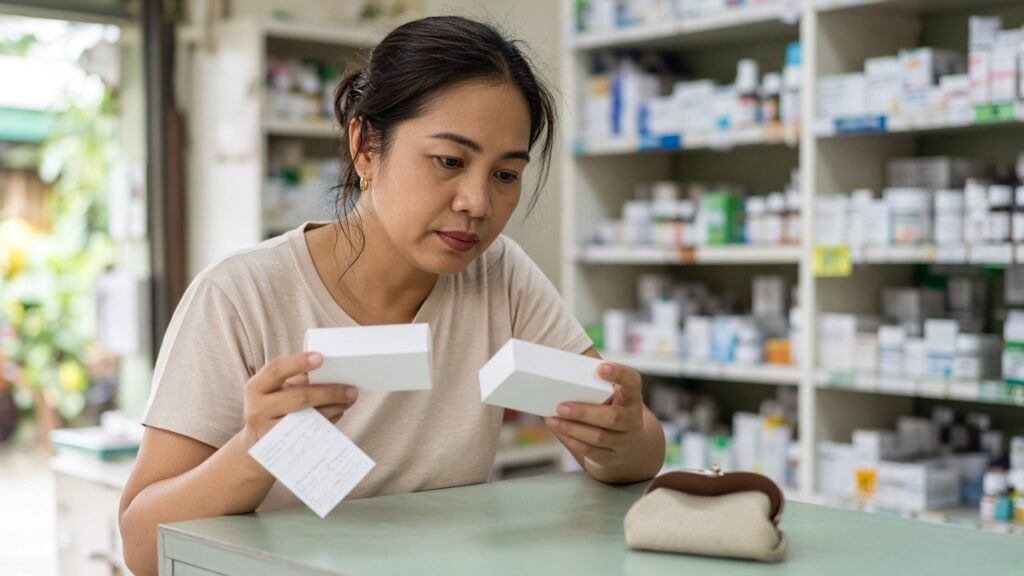
Kapag may maintenance ka, o may nagkasakit sa bahay, mabilis maubos ang budget sa botika. A month of blood pressure or diabetes pills, plus the occasional antibiotic or cough syrup, can quietly eat a big chunk of the sahod. The good news: Filipinos have more legal, practical ways to pay less for medicines than most people realize. Some are laws that have been around for decades, and some are newer PhilHealth benefits that many members still haven’t used.
This guide walks you through the options, from asking for generics to claiming free outpatient medicines under PhilHealth. One important reminder before we start: saving money should never mean skipping doses or self-medicating. Always talk to your doctor or pharmacist before changing any medicine.
1. Ask for the generic version (it’s your right)
The Generics Act of 1988 (Republic Act No. 6675) requires doctors, including private practitioners, to write prescriptions using the generic name. The brand name may be added, but the generic name has to be there. The same law requires drug outlets to tell buyers about other products with the same generic name and their prices, so you can choose.
In practice, this means you can walk into a botika with a prescription for, say, amlodipine or metformin and ask, “Ano po ang pinakamurang available na generic nito?” Generic medicines contain the same active ingredient, and the law tasks the government with certifying their quality. The price difference between a big brand and a generic of the same molecule can be large, so it is always worth asking.
A few practical tips:
- Read the generic name on your prescription. If your doctor only wrote a brand, ask them to add the generic name or say whether a generic is okay for you.
- Check the strength and form. 5 mg is not the same as 10 mg, and a tablet is not the same as an extended-release tablet. Match exactly what was prescribed.
- Ask your doctor before switching if you are on a sensitive medicine or you notice any change in how you feel after switching.
2. Look for the red “Retail Price” strip on regulated medicines
The Cheaper and Quality Medicines Act of 2008 (Republic Act No. 9502) allows the President to set maximum retail prices on certain drugs. Under Executive Order No. 155, covered medicines must not be sold above the maximum retail price, and that price is printed on the label after the words “RETAIL PRICE” on a red strip.
Not every medicine is covered, so don’t expect a red strip on everything. But if you see one and the cashier charges more than what’s printed, you have the right to question it. Keep your receipt, and you can report the drugstore to the Department of Health or the Food and Drug Administration (FDA).
3. Use PhilHealth YAKAP and GAMOT for free outpatient medicines
This is the one most Filipinos are missing out on. PhilHealth’s YAKAP program (Yaman ng Kalusugan Program, the expanded version of Konsulta) offers free primary care consultations, selected laboratory tests and, through the GAMOT package, free outpatient medicines. According to the Philippine Information Agency, GAMOT covers 75 essential medicines worth up to ₱20,000 per beneficiary per year.
The covered list includes common medicines for infections, high blood pressure, diabetes, high cholesterol, asthma and COPD, plus supportive drugs like paracetamol and oral rehydration salts. GMA News published the full list, which includes amlodipine, losartan, metformin, atorvastatin and salbutamol, among others.
How to claim it, based on PIA’s guide:
- Register with a YAKAP clinic of your choice. You can sign up through the eGovPH app, the PhilHealth Member Portal, any PhilHealth office, or directly at the clinic. You’ll need your PhilHealth Identification Number (PIN).
- Consult your YAKAP doctor. After an assessment, the doctor may issue a GAMOT prescription slip with a security code if you need medicines on the list.
- Claim at an accredited GAMOT pharmacy. Present the prescription slip and any government-issued ID.
Be realistic about the limits. The benefit is not cash, it is not automatic, it only covers medicines on the list, and unused amounts don’t carry over to the next year, as PIA explains. PhilHealth has also acknowledged in a 2026 member advisory that some YAKAP clinics still needed time to complete requirements before issuing GAMOT prescriptions, and that availability of the expanded list started in selected areas. If you have trouble, the advisory lists PhilHealth’s 24/7 Corporate Action Center at (02) 866-225-88 or [email protected].
Not sure if your PhilHealth is active? Our guide on PhilHealth contribution rates and how to pay covers how to check your records.
4. Claim your senior citizen or PWD discount every time
If you are a senior citizen or a person with disability, you are entitled to a 20% discount and VAT exemption on medicines, on top of other benefits. Bring your ID and your prescription and purchase booklet when required. We explain the rules and common mistakes in our senior citizen and PWD discount guide. Many families lose money simply because Lolo’s ID was left at home, so keep a photocopy and the booklet in one pouch with the medicines.
5. Compare prices before you buy (sulit ang ilang minuto)
Prices for the same generic medicine can vary between drugstores, and even between branches. A few habits help:
- Ask two or three botika near your home or office for the price of your maintenance medicine. Write it down in your phone.
- Ask about government pharmacies. Some LGUs and government hospitals run their own pharmacies or Botika ng Bayan outlets. Availability and prices depend on your area, so check with your barangay health center or city hall.
- Buy maintenance medicines in a sensible quantity. Buying a month’s supply at once can save you repeated trips and fares, but check the expiry date and don’t stock more than you can use.
- Ask if the store has a suki or loyalty program. Treat it as a small bonus, not a reason to buy what you don’t need.
6. Ask your barangay health center first
Before buying, check if your barangay health center or rural health unit has what you need. Government health centers often provide basic medicines, vaccines and family planning supplies, especially for children, pregnant women and patients enrolled in public health programs. Stock varies, so it helps to ask the health worker when supplies usually arrive.
For hospital bills and expensive medicines after a confinement, ask the hospital’s social service office or the Malasakit Center (if your hospital has one) about government medical assistance. Bring your prescription, medical abstract, valid ID and a quotation of the medicines.
7. Beware of “too cheap” online sellers
It’s tempting to buy medicines from random Facebook pages or online shops offering prices way below the botika. Be careful. Fake or unregistered medicines are a real risk, and a “bargain” that doesn’t work, or harms you, is the most expensive purchase of all. Buy from licensed drugstores, check that the product is registered using the FDA’s verification tools on the FDA website, and avoid sellers who ask you to pay first via GCash to a personal account with no receipt. Our guide on how to spot money scams covers the red flags.
8. Budget for medicines like a monthly bill
If someone in the household has a maintenance medicine, treat it like Meralco or water: a fixed monthly expense. Here’s a simple way to plan:
- List every medicine taken regularly, with the dosage and how many tablets are used per month.
- Write the price you actually pay (after generics, discounts or GAMOT) and multiply by the monthly quantity.
- Set that amount aside on payday, ideally in a separate wallet or e-wallet pocket, so it’s never “nagamit sa iba.”
- Keep a small health buffer in your emergency fund for sudden antibiotics, check-ups or lab tests.
Once you see the real monthly total, it becomes easier to spot savings, like switching a branded medicine to a generic with your doctor’s okay, or moving covered medicines to your GAMOT benefit.
Quick checklist
- Ask for the generic name and the cheapest available generic.
- Check for the red “Retail Price” strip on regulated medicines.
- Register with a PhilHealth YAKAP clinic and ask about GAMOT.
- Bring senior citizen or PWD IDs and booklets.
- Compare two or three drugstores and ask your health center.
- Buy only from licensed sellers and FDA-registered products.
- Budget maintenance medicines as a fixed monthly expense.
Health is one area where cheaper should never mean riskier. With generics, price caps, PhilHealth benefits and a little comparison shopping, you can cut your medicine spending legally and safely, without cutting corners on your health.
This article is general information only and not financial advice. Rates, rules and fees change, so please verify with the provider or the official agency before deciding.