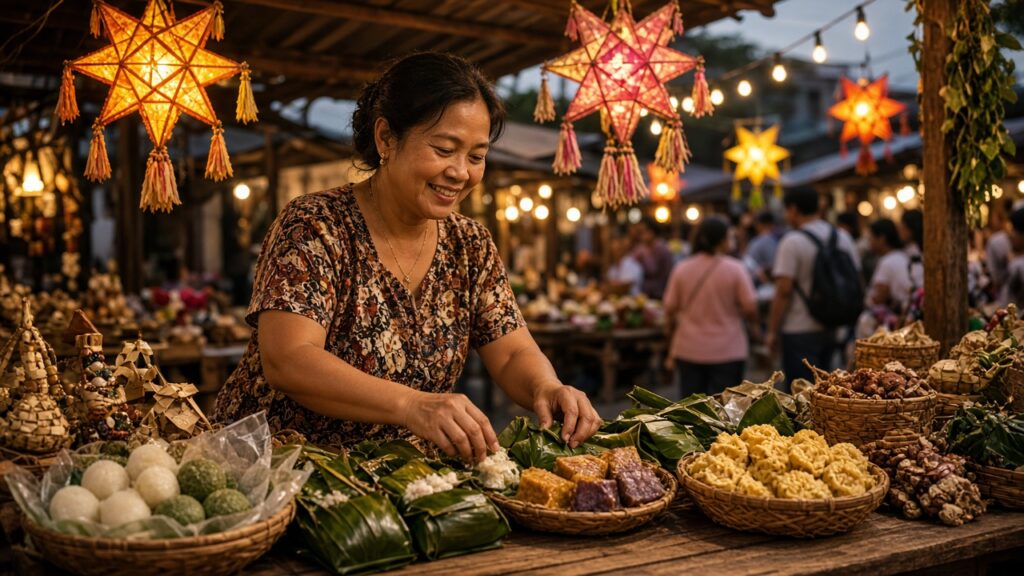
Every November, malls, schools, offices, churches and barangay halls fill up with Christmas bazaars and tiangge. A bazaar is a small business, not a sure thing, and this guide won’t promise you a certain income. For many Filipinos, renting a table for a weekend is the easiest way to earn extra pesos before the holidays, whether you sell food, gifts, preloved items or handmade crafts.
But a lot of first-time sellers go home tired, with leftover stock and less money than they started with. The table fee, transport, packaging and unsold items quietly eat the profit. This guide walks you through how to do Christmas bazaar selling the practical way: compute your real costs, price properly, follow the basic rules, and decide if a bazaar is even worth it for you.
Step 1: Check the Bazaar Before You Pay the Table Fee
The table or booth fee is usually your biggest fixed cost, and organizers set their own rates, so there is no standard price. Before you pay a reservation fee, ask the organizer these questions:
- How many days and what hours? A one-day school fair and a two-week mall bazaar need very different amounts of stock and manpower.
- What is included? Table, chairs, electricity, signage, Wi-Fi, security, storage overnight?
- Who is the crowd? Office workers on lunch break buy snacks and small gifts. Families on weekends may buy food, toys and décor. Students have smaller budgets.
- How many sellers sell the same thing? Ten milk tea booths in one hallway means you are fighting for the same buyers.
- Are permits handled by the organizer? Some organizers secure the event permit; others require each seller to have their own papers.
Ask for this in writing (a Messenger chat or email is fine) and get an official receipt or invoice for what you pay. If an “organizer” only has a new Facebook page, no venue confirmation and asks for full payment by GCash to a personal account, be careful. Call the venue directly to confirm the event exists. See how to spot money scams.
Step 2: List Every Cost, Not Just the Products
Many sellers only count the cost of the items they sell. That is how “sold out” can still mean “lugi.” Write down all of these:
- Fixed costs: table fee, reservation fee, permit fees, signage, tablecloth, display stands, extension cords.
- Daily costs: transport or gas, parking, meals, helper’s pay, ice, load or mobile data.
- Per-item costs: product or ingredients, packaging, labels, stickers, ribbons, paper bags.
- Payment costs: any fees if you accept card or QR payments through a provider that charges merchants. Ask your provider what applies to your account.
- Losses: food that spoils, items that get damaged, freebies and taste samples.
A sample computation (illustration only)
Say Liza plans to sell homemade ube crinkles at a two-day office bazaar. These are made-up numbers just to show the math:
- Table fee for two days: ₱1,500
- Transport, meals and a tablecloth: ₱900
- Fixed and daily costs total: ₱2,400
- Cost per pack (ingredients, box, sticker): ₱45
- Selling price per pack: ₱90
- Profit per pack before fixed costs: ₱45
To cover ₱2,400 in fixed and daily costs, Liza needs to sell ₱2,400 ÷ ₱45 = about 54 packs just to break even. Pack number 55 is where profit starts. If she only sells 40 packs, she loses money even though she was busy all weekend.
This break-even number is the single most useful thing to know before you join. If you honestly think you can only sell 30 packs at this event, either negotiate a smaller table fee, share a table with another seller, raise your margin, or skip this bazaar.
Step 3: Price for Profit (and Still Look Fair)
Pricing is where many first-time sellers undercharge, especially for food and handmade items where your own time is invisible. A few practical rules:
- Start from cost, then check the market. Know your cost per item first, then walk around or look online at what similar products sell for.
- Include your time. If baking 100 packs takes you two full days, that labor has value even if you do not pay yourself a salary.
- Use bundles instead of discounts. “3 for ₱250” moves more stock than cutting the price of one item, and you keep a better margin.
For a deeper walkthrough on food, see our guide on how to price homemade food products.
Display your prices clearly
This is not just good selling, it is the law. Under Article 81 of the Consumer Act of the Philippines (RA 7394), it is unlawful to offer a consumer product for retail sale without a price tag, label or marking publicly displayed, and the product cannot be sold at a higher price than what is stated. If items are too small to tag, a price list near the display is allowed. Article 82 adds that prices should be written clearly, per unit, in pesos and centavos.
Step 4: Permits, Registration and Taxes
Rules differ by city and by event, so confirm with the organizer and your city or municipal Business Permits and Licensing Office (BPLO). Here is the general picture:
- Event or temporary permits. Many organizers handle the permit for the whole bazaar. Others ask sellers for their own business permit or a special permit from the LGU. Ask before you pay.
- DTI business name. If you sell under a brand name instead of your own name, the DTI says you are required to register that business name. Based on the DTI BNRS FAQ, fees are ₱200 for barangay scope, ₱500 city or municipality, ₱1,000 regional and ₱2,000 national, plus ₱30 documentary stamp tax, valid for five years. The DTI also notes that a business name registration is not a permit to operate; you still need a business or mayor’s permit. See our DTI business name registration guide.
- BIR registration. Under the Ease of Paying Taxes Act (RA 11976), the ₱500 annual registration fee was removed, according to the BIR’s EOPT flyer. Registering is still required if you are regularly doing business, and registered sellers are expected to issue invoices and file returns.
- Income tax options. Per the BIR digest of RMO No. 23-2018, self-employed individuals whose gross sales do not exceed ₱3,000,000 may choose either graduated rates or an 8% tax on gross sales in excess of ₱250,000 (in lieu of graduated rates and percentage tax). Our 8% tax option guide explains how to choose.
- Food products. If you sell processed or packaged food, check with the organizer and the Food and Drug Administration (FDA) about what applies to your product, especially if you plan to sell beyond a one-time event. Some venues also require a health certificate for food handlers, so ask early.
If the bazaar turns into a regular business, you can also look into BMBE registration and free help from a DTI Negosyo Center.
Step 5: Plan Your Stock So You Don’t Drown in Leftovers
Leftover stock is cash you cannot use for Noche Buena. A few ways to manage it:
- Start small for your first event. Bring a modest quantity of your best items and note what sells out first.
- Take pre-orders. Post your menu or catalog on your page or group chats a few days before the bazaar and let people reserve. Pre-orders tell you what to produce.
- Choose items that keep. Non-perishables (crafts, décor, accessories, sealed snacks with long shelf life) can be sold at the next event or online. Fresh food must sell that day.
Step 6: Handle Cash and E-Wallet Payments Safely
- Prepare change. Have plenty of coins and small bills. Losing a sale because you cannot break a ₱1,000 bill is common.
- Accept QR payments, but verify. Check that the payment actually landed in your app before handing over the item. Do not rely on a screenshot shown by the buyer, since screenshots can be faked.
- Separate your money. Keep your capital, your sales and your personal money in different pouches or accounts. The cash envelope method works well here.
Is a Christmas Bazaar Worth It for You?
After the event, do a quick review. Total sales minus all costs (including table fee, transport, meals and leftover losses) is your actual profit. Divide it by the hours you spent preparing and selling. If the result is lower than what you could earn doing something else with those hours, it might be better to sell through pre-orders or online instead, or to join only the busiest bazaars.
Even a modest bazaar can bring customer feedback and repeat buyers. Treat it as a test, keep a simple daily tally of stock and sales, and grow from what the numbers tell you.
This article is general information only and not financial advice. Rates, rules and fees change, so please verify with the provider or the official agency before deciding.