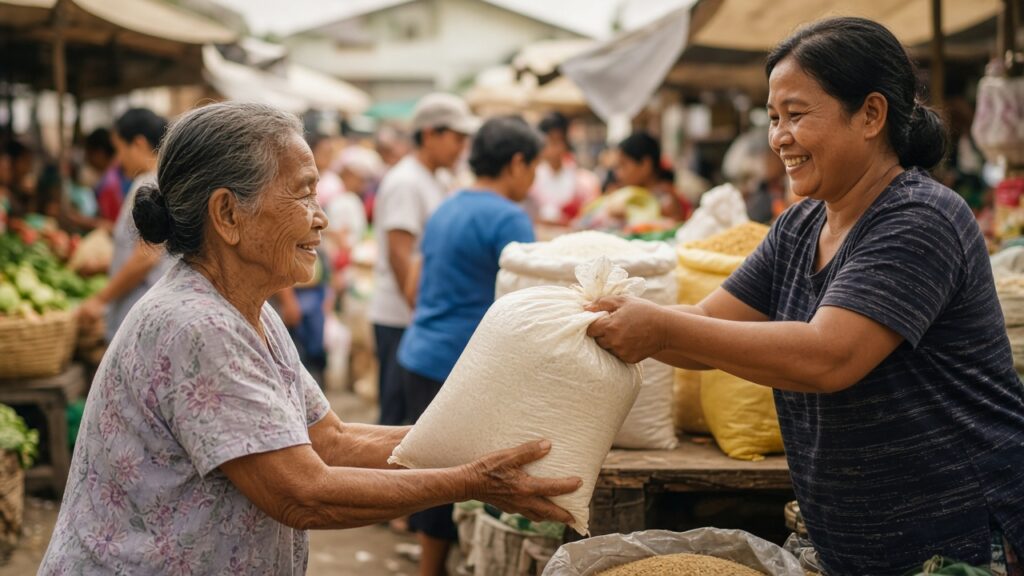
Rice is the one item almost every Filipino household buys every week, and for many families it is the biggest single line in the grocery budget. That is why the government’s ₱20-per-kilo rice program, officially called “Benteng Bigas, Meron Na!”, matters for your wallet. If you qualify, it can free up real pesos every month for bills, baon, or your emergency fund.
But there is a lot of confusion: Who can buy? How many kilos? Do you need an app? This guide explains the rules based on the Department of Agriculture’s (DA) official guidelines and recent government announcements, plus practical tips so you don’t waste a trip to the P20 Center.
What is the ₱20 rice program?
The P20 Rice Project is run by the DA under its Kadiwa ng Pangulo “Rice-for-All” program. According to the DA’s implementing guidelines (Memorandum Circular No. 50, Series of 2025), it makes rice available at ₱20 per kilogram through Kadiwa ng Pangulo outlets and other accredited “P20 Centers” nationwide. The rice is sourced mainly from palay bought from local farmers by the National Food Authority (NFA), and the subsidy is handled through Food Terminal Inc. (FTI).
This is not a one-week promo. The DA has said the President wants the program extended until June 2028, and the DA reported that the government allocated ₱23 billion in 2026 to subsidize it, with a target of 15 million households by the end of 2026.
Who can buy ₱20 rice?
The program is not open to everyone. Under the DA guidelines, eligible beneficiaries include:
- Members of poor and near-poor households identified through the PSA’s Community-Based Monitoring System (CBMS)
- Senior citizens, persons with disabilities (PWDs), solo parents, and Indigenous Peoples
- 4Ps (Pantawid Pamilyang Pilipino Program) beneficiaries
- Walang Gutom Program beneficiaries endorsed by DSWD
- Registered farmers, farmworkers and fisherfolk (RSBSA or FishR)
- Groups from the 2025 rollout such as minimum wage earners, TODA members, jeepney and bus operators and drivers, and public school teaching and non-teaching personnel
- Lower-middle-income households endorsed by their LGU
Other sectors can be added only if recommended by the program’s technical working group and approved by the DA Secretary. So if a neighbor says “pwede na raw lahat,” check first. Eligibility depends on being in the official list or successfully registering.
How many kilos can you buy?
The DA guidelines set limits per beneficiary group. Here is the official table:
| Beneficiary group | Max per month | Max per purchase |
|---|---|---|
| Senior citizens | 30 kg | 10 kg |
| Solo parents | 30 kg | 10 kg |
| Persons with disabilities | 30 kg | 10 kg |
| 4Ps beneficiaries | 30 kg | 10 kg |
| Walang Gutom Program beneficiaries | 30 kg | 10 kg |
| Farmers and farmworkers | 10 kg | 10 kg |
| Fisherfolk | 10 kg | 10 kg |
| Jeepney and tricycle drivers | 10 kg | 10 kg |
| Minimum wage earners | 10 kg | 10 kg |
| Teachers and non-teaching personnel | 10 kg | 10 kg |
Source: DA Memorandum Circular No. 50, s. 2025. The same circular says the DA Secretary may adjust these monthly limits through a memorandum, and some local rollouts have announced their own arrangements (for example, a PIA report on an NFA warehouse in Ilocos Sur described a different limit for farmers). Always confirm the current limit at your P20 Center.
How to register: the P20 App and QR code
The program now runs on a QR-code system to prevent double buying and to keep records for audit. The official platform is the P20 App, a web app at p20.da.gov.ph. Based on the DA guidelines, here is how it works:
- Check if you’re already listed. Use the P20 BeneFinder feature. If you’re in a government database (for example CBMS, RSBSA, 4Ps, senior citizen, PWD or solo parent lists), you are considered pre-identified. You just need to verify and confirm your details to get your QR code.
- If you’re not listed, self-register. The guidelines allow a one-time self-registration through the official P20 web app. You’ll need to submit a valid ID that proves you belong to an eligible group. A verification team reviews it, and only approved applicants get a QR code.
- Find the nearest outlet. The app’s P20 BenteFinder feature shows the P20 Center nearest to your location.
- Buy at the P20 Center. Bring your QR code and ID. Staff record the sale in the system, which checks it against your allowed limit, and you get an electronic acknowledgment receipt.
The DA has also encouraged beneficiaries to register through the P20 app for faster transactions. If you have no smartphone, ask your barangay, LGU social welfare office or the P20 Center staff for help. Many local rollouts are done together with LGUs.
What IDs should you bring?
Bring an ID that matches your category, plus a government-issued ID like your National ID. Examples mentioned in the PIA guide: senior citizen ID, 4Ps ID, RSBSA ID for farmers, and an LTFRB or franchise-based ID for transport workers. Solo parents and PWDs should bring their solo parent ID or PWD ID. Bring a photocopy too. Some centers ask for one.
How much can you actually save?
Let’s do simple math with an example. Rice prices differ by area and variety, so use what you actually pay at your palengke:
- Say your usual rice costs ₱50 per kilo (example only).
- A senior citizen buying the full 30 kg a month at ₱20 pays ₱600 instead of ₱1,500. That’s ₱900 saved per month.
- A minimum wage earner buying 10 kg pays ₱200 instead of ₱500. That’s ₱300 saved per month.
Over a year, ₱300 a month is ₱3,600, enough for a small emergency fund starter or a chunk of your 13th month “pang-Noche Buena” budget without touching the bonus itself.
Make the savings count
The trap with any discount is that the “saved” money quietly disappears into extra snacks or online checkouts. A few habits help:
- Move the difference right away. On the day you buy, transfer the amount you saved (e.g., ₱300) to a separate savings account or e-wallet savings feature. Treat it like a bill.
- Plan your trips. Because of the per-purchase cap (10 kg under the DA table), seniors and other 30-kg groups may need several trips a month. Factor in fare. If a round trip costs ₱60, buying 10 kg still saves you money, but not as much as you think.
- Store rice properly. Keep it in a clean, dry, covered container so you don’t lose any to pests or moisture.
- Coordinate with family. If your lolo or lola qualifies, the household can plan meals around that supply. Just remember the allocation is per registered beneficiary. Don’t use someone else’s QR code.
Watch out for schedule changes and scams
Sales can be paused. For example, GMA News reported that P20 Centers in Metro Manila had no sales from November 16 to 18, 2026 during the ASEAN Summit holidays, resuming November 19. Check your LGU’s or the DA’s official pages before you go.
Also be careful with:
- “Registration fee” offers. The DA guidelines describe registration through the official app and verification teams. If someone asks you to pay to “get listed,” that’s a red flag.
- Fake links and pages. Use only p20.da.gov.ph and official DA or LGU channels. Never share your OTP or bank details for a rice registration.
- Unauthorized “P20” sellers. The DA circular says only accredited outlets may use the P20 Rice Project name and branding.
If you get scammed, report it right away. See our guide on how to report an online scam in the Philippines.
Not eligible? Other ways to save on rice
If you aren’t in an eligible group, you can still cut your rice bill. Compare per-kilo prices across stalls, buy in sizes you can store well, and look for regular Kadiwa ng Pangulo events in your area. They often sell farm products directly from farmers’ groups. Pair this with our grocery saving tips and a simple expense tracker to see where your food money really goes.
Quick checklist
- Check if you belong to an eligible group.
- Look yourself up on p20.da.gov.ph (BeneFinder) or self-register with a valid ID.
- Get your QR code and find the nearest P20 Center.
- Know your limit (30 kg/month for seniors, PWDs, solo parents, 4Ps and Walang Gutom; 10 kg for others, per the DA table).
- Bring your QR code, valid ID and a photocopy.
- Save the difference, don’t spend it.
This article is general information only and not financial advice. Rates, rules and fees change, so please verify with the provider or the official agency before deciding.