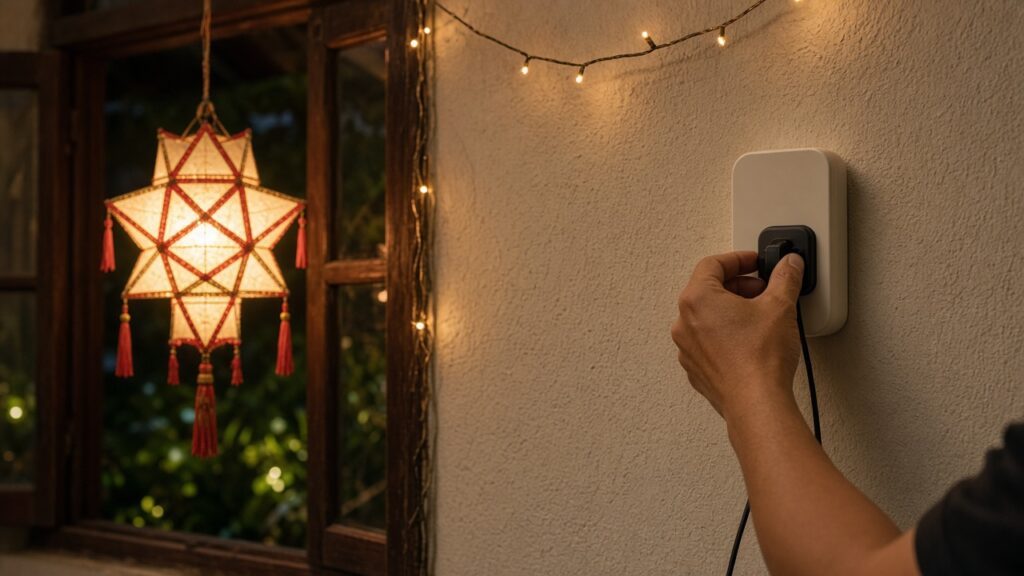
Pagdating ng Disyembre, sabay na umiilaw ang parol, ang Christmas tree at ang bintana ng kapitbahay. Then January comes, and so does the Meralco bill. Many families blame the lights, while others say lights barely add anything. The honest answer is in between, and you can work it out yourself in five minutes using the watts on the label and the rate on your bill.
This guide shows you how to compute what your Christmas lights really cost, using Meralco’s official November 2026 rate, and how to keep the twinkle without the bill shock.
Step 1: Know your rate per kWh
Electricity is billed per kilowatt-hour (kWh). For November 2026, Meralco announced an overall rate of ₱15.5510 per kWh for a typical household using 200 kWh, up ₱0.4895 from ₱15.0615 in October (Meralco advisory, November 13, 2026).
That ₱15.5510 is not the same for everyone. Meralco’s own table of residential bills at typical consumption levels for November 2026 shows the effective rate rising as usage goes up:
| Monthly use | Total bill (Nov 2026) | Effective rate per kWh |
|---|---|---|
| 100 kWh (non-lifeline) | ₱1,568.03 | ₱15.6803 |
| 200 kWh | ₱3,110.19 | ₱15.5510 |
| 300 kWh | ₱4,757.92 | ₱15.8597 |
| 400 kWh | ₱6,468.10 | ₱16.1703 |
| 500 kWh | ₱8,367.96 | ₱16.7359 |
The table assumes a 0.50% local franchise tax, which varies by city, so your actual bill can differ slightly. If you are not a Meralco customer, divide your last bill’s total by the kWh used to get your own rough rate. Rates change every month, so use the latest figure you have.
Step 2: Read the watts on your lights
Every legitimate set of lights should show its wattage on the box, the tag, or the plug. Write down the watts for each string, parol and lighted decoration you plan to use. If there is no wattage and no safety marking at all, that is a warning sign (more on that below).
Step 3: Do the math
Use this formula:
Watts ÷ 1,000 × hours per night × number of nights = kWh
kWh × your rate = cost in pesos
Here is an example using hypothetical label values. Change the numbers to match your own lights. We use 40 nights (roughly December 1 to the first week of January) and Meralco’s ₱15.5510 November rate.
| Setup (example) | kWh for 40 nights | Estimated cost |
|---|---|---|
| 1 string labeled 40 W, 6 hours a night | 9.6 kWh | ₱149.29 |
| 5 strings labeled 40 W, 6 hours a night | 48 kWh | ₱746.45 |
| 5 strings labeled 40 W, left on 12 hours a night | 96 kWh | ₱1,492.90 |
| 1 LED string labeled 5 W, 6 hours a night | 1.2 kWh | ₱18.66 |
| 5 LED strings labeled 5 W, 6 hours a night | 6 kWh | ₱93.31 |
Two lessons jump out. First, wattage matters more than the number of bulbs. In this example, the same five strings cost about ₱650 less for the season when they draw 5 W instead of 40 W. Second, hours matter just as much. Leaving lights on all night doubles the cost, and nobody is looking at the parol at 3 a.m.
The hidden cost: crossing into a higher bracket
Look again at Meralco’s table. At 200 kWh the effective rate is ₱15.5510, but at 300 kWh it is ₱15.8597, and at 500 kWh it is ₱16.7359. That happens because some charges use a higher rate once your total consumption goes up. In Meralco’s November 2026 rate schedule, the residential distribution charge is ₱1.0404 per kWh up to 200 kWh, ₱1.3532 for 201 to 300 kWh, ₱1.6484 for 301 to 400 kWh and ₱2.1627 above 400 kWh. The bracket is based on your total use for the month, so the higher rate covers every kWh, not just the extra ones.
So if your household normally uses around 180 to 200 kWh, a big light display plus extra cooking, guests and electric fans running for parties can push you past 200 kWh. Your bill then goes up by more than just the lights’ own kWh. If you are near a threshold, a smaller or LED-only display is the safer choice.
There is another reason to watch the 200 kWh line this season. Meralco said that for customers using 200 kWh or below, the suspension of disconnection has been extended until December, provided unpaid May to July 2026 bills are settled on or before November 26, 2026. Bills for August to October 2026 must be paid on or before December 26, 2026 (Meralco advisory). If you have unpaid bills, settle them first before buying new decorations.
Low-consumption households may also qualify for the lifeline discount. See our guide on the Lifeline Rate to check if you can get a lower bill.
Switching to LED: how much can it save?
According to ENERGY STAR, certified decorative light strings use about 92% less energy than conventional incandescent strings, are limited to no more than 0.2 W per bulb, and can last up to 10 times longer. It also notes that the electricity used by just one 7-watt incandescent bulb could power 140 LEDs. Many LED sets sold here are not ENERGY STAR certified, so always compare the actual watts on the label instead of assuming.
Should you throw away your old lights right away? Not necessarily. If your old sets are still safe and you only use a few strings for a few hours, the savings from replacing them may be small. Replacing makes the most sense when:
- your old lights are high-wattage and you use many strings,
- you keep them on for many hours every night, or
- the wires are cracked, frayed or the bulbs get hot, which is a safety problem, not just a cost problem.
Before buying, compute the new set’s price against the pesos you will save per season. If it takes many seasons to pay back, keep using your old safe lights and just cut the hours.
Buy certified lights: cheap can be costly
The DTI reminds consumers that Christmas lights sold in the country must carry either the Philippine Standard (PS) mark or the Import Commodity Clearance (ICC) sticker to show they passed the required certification (PIA, November 2026). Locally made lights carry the PS mark, while imported ones carry the ICC mark. DTI Davao also warned that some sellers use fake ICC marks, and that genuine ICC marks now carry a QR code you can scan to see the manufacturer and whether the certification is still valid (SunStar Davao).
The full list of products under mandatory certification is on the Bureau of Philippine Standards website. A ₱50 saving on an uncertified set is not worth a fire or a burnt outlet. If you see covered products sold without the marks, you can report them to the DTI or your local Negosyo Center.
Practical ways to cut your Christmas lights bill
- Set fixed hours. For example, 6 p.m. to 11 p.m. only. A simple plug-in timer helps if your family tends to forget.
- Unplug before sleeping or leaving the house. Meralco itself reminds customers to unplug Christmas lights and appliances when not in use or before going to bed, mainly for safety (Daily Tribune). It saves pesos too.
- Light what people actually see. One parol by the window and lights on the tree look festive enough. Skip the strings on the back wall nobody passes.
- Use solar-powered lights outdoors. For the gate or garden, solar sets draw nothing from your meter. Check that they are durable enough for rain.
- Avoid “octopus” connections. Meralco warns against plugging extension cords into each other or overloading outlets, a common cause of fire. Fewer, lower-watt strings make this easier.
- Inspect before reusing. Check old sets for cracked or frayed wires. Damaged lights waste money if they cause a short or a fire.
- Do your own budget line. Add “Christmas lights: ₱___” to your Christmas budget so the January bill is not a surprise.
Quick checklist before you plug in
- I know my rate per kWh from my latest bill.
- I listed the watts of every light and decoration.
- I computed the season’s cost using the formula above.
- My lights have a PS mark or a genuine ICC sticker.
- I set fixed hours and we unplug before sleeping.
- My unpaid electric bills, if any, are settled first.
Christmas lights are part of the Filipino Pasko, and you do not need to give them up. Just treat them like any other expense: know the cost, set a limit, and choose safe, efficient sets. For more ways to lower your bill all year, read our 10 practical tips to lower your Meralco bill and our guide to the DOE energy label.
This article is general information only and not financial advice. Rates, rules and fees change, so please verify with the provider or the official agency before deciding.