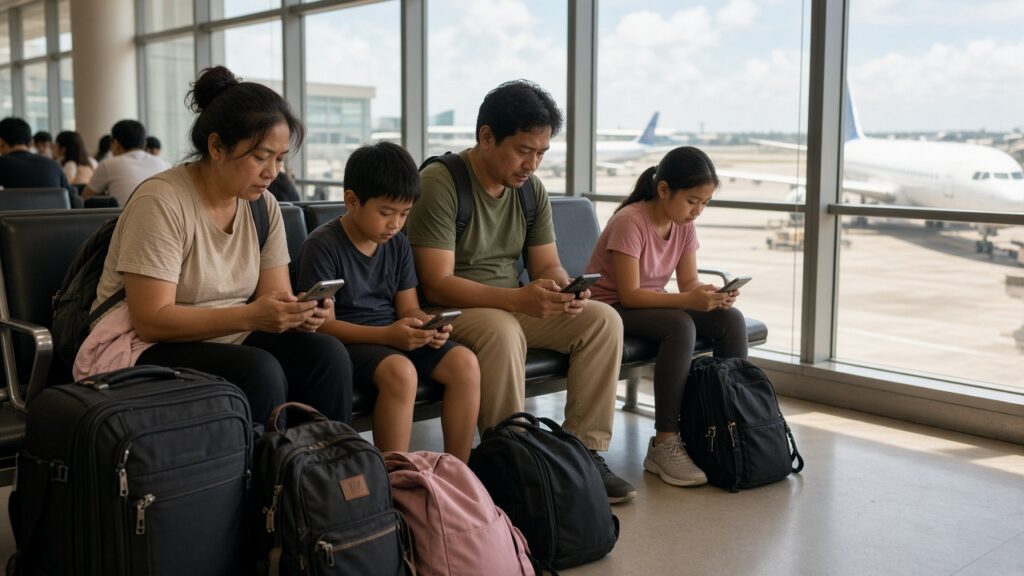
December is peak travel season. You booked that seat sale months ago to go home for Noche Buena, then the gate announcement comes: “Your flight has been delayed.” Or worse, a text saying it was cancelled. Instead of just buying a new ticket, know that you may be entitled to meals, free rebooking, a refund or even cash compensation.
This guide explains the main rules in plain Filipino-friendly terms, based on the official Civil Aeronautics Board (CAB) Summary of the Rights of Air Passengers under CAB Economic Regulation No. 9, as amended, better known as the Air Passenger Bill of Rights (APBR). The DTI also publishes the full text of the regulation on its consumer page.
Why this matters for your wallet
A missed flight in December can mean a walk-in fare several times your promo fare, an extra hotel night and airport-priced food. Many passengers accept the first offer because they do not know they can ask for more. The APBR sets minimum obligations, so you can calmly ask for what you are owed.
First, show up on time. The CAB summary says a passenger inside the check-in area at least one hour before the scheduled time of departure (STD) shall not be considered a no-show and shall not be denied check-in. Online check-in passengers should be there at least one hour before STD for international and 45 minutes for domestic flights. Being a no-show at the gate is a valid reason to refuse boarding, so arrive early during the holiday rush.
Flight delays: what you can ask for
The APBR treats delays inside the terminal and delays on the tarmac (when you are already inside the plane) differently.
Terminal delay of at least 2 hours
Once your flight is delayed at least two hours after the STD, whether or not the airline caused it (even bad weather), you are entitled to:
- Sufficient refreshments or meals
- Free phone calls, texts and internet access
- First aid, if necessary
Do not be shy to ask the counter for your meal or voucher.
Terminal delay of at least 4 hours caused by the airline
If the delay reaches at least four hours after the STD for causes attributable to the airline (for example, aircraft or crew issues, not a typhoon), you may treat the flight as cancelled and get the rights and amenities that apply to a cancellation. If you choose to continue with the flight, the airline must give you:
- Compensation equivalent to at least the value of the sector delayed, in cash or voucher at the airline’s discretion; and
- The right to board the flight even if it leaves more than four hours after the STD.
Before you decide, ask the airline in writing what caused the delay and what exactly they are offering. That record helps if you later need to file a complaint.
Tarmac delay of 3 hours
If you are stuck inside the plane for three hours from door closing (or after touchdown), the airline must provide food, drinking water, working air-conditioning and toilets, medical help if needed, and updates, and should let passengers deplane except for safety or security reasons or when departure is expected within 30 minutes (Joint Memorandum Circular No. 001, series of 2023, as cited by the CAB).
Flight cancellations: it depends on timing and cause
Cancelled more than 7 days before departure
You should be notified and you can choose a refund or a rebooking. There is no fee for the first rebooking, but a fare difference may apply.
Cancelled 7 days or less before departure, due to force majeure
If the cancellation is due to force majeure or reasons not attributable to the airline (like a typhoon), you may choose a refund, a rebooking, or a special replacement flight at no additional cost. For rebooking, no fare difference or rebooking fee is payable if the new flight is within 30 days of your original departure date. If the cancellation happens within 24 hours and you are already at the airport, you also get refreshments or meals, free calls, texts and internet, first aid, and help coordinating with hotels or transport, though the cost of lodging and transport is on the passenger in this case.
Cancelled 7 days or less before departure, due to the airline
When the cause is not force majeure, your options are wider. You can choose among:
- A refund
- A rebooking with no fare difference, and no rebooking or other fees for the first rebooking
- A special replacement flight at no additional cost
- Endorsement to another airline or other transport, with no fees or fare difference
- Purchase by the airline of a one-way ticket on a third-party airline for the cancelled sector, subject to conditions in the APBR
If the flight is cancelled 24 hours or less before departure and you are already at the airport, you are also entitled to meals, free communication, first aid, and hotel accommodation plus transport between the airport and hotel.
Bumped because of overbooking? You may get ₱5,000 or more
If a flight is overbooked, the airline must first ask for volunteers to give up their seats in exchange for compensation, raising the offer if needed. Passengers on the priority list, such as unaccompanied minors, seniors, PWDs, those with children under four, and connecting passengers, should board first.
If you are involuntarily denied boarding, the CAB summary says you can get the higher of:
- The full value of your fare, including taxes, surcharges and optional services; or
- ₱5,000 for domestic flights or ₱10,000 for international flights
You should also be prioritized on the next flight or endorsed to another airline, and given hotel accommodation if necessary (for example, an overnight delay) and lounge access if available. Example: if your promo fare was ₱1,800, the ₱5,000 minimum is higher, so that is what you can ask for.
Missed connections and forced downgrades
- Misconnection: If you miss a connecting flight on the same or a conjunction ticket because of the airline’s fault, the airline must rebook you or make other arrangements at its sole cost. Self-booked separate tickets may not be covered, so leave generous connection time.
- Downgrade: If you are forcibly moved to a lower class, you get the fare difference back plus a penalty equal to 50% of the fare difference. The CAB summary states this extra amount should not be less than ₱5,000.
Step-by-step: what to do when your flight goes wrong
- Stay calm and document. Take photos of the flight board, keep your boarding pass, booking confirmation, texts or emails from the airline, and receipts for any food, hotel or transport you paid for.
- Ask for the cause in writing. Whether the reason is force majeure or the airline’s fault changes your remedies.
- Choose your remedy carefully. A voucher is not always your only option. If you are entitled to a refund and prefer cash back, say so clearly.
- Go to the CAB Passenger Rights Action Desk (PRAD) at major airports if the airline staff will not help. The CAB lists a 24/7 public assistance hotline (165-66) and PRAD numbers per airport.
- File a complaint online through the CAB’s Online Passenger Complaint Form if the issue is not resolved. Attach your documents and keep the reference number.
If an amount is still unpaid after the CAB process, you may also consider our guide to small claims court.
Money-saving habits for holiday flights
- Book earlier flights in the day. Delays tend to pile up as the day goes on, and an early flight leaves more options if something goes wrong.
- Read the fare rules before paying. Rules for passenger-initiated changes (when you are the one who cancels) depend on the fare type you bought, not the APBR protections above.
- Budget for the extras. Baggage, seat selection and the travel tax for international trips can add up. Put them in your Christmas budget so a seat sale does not become an “utang sale.”
- Keep a small travel buffer. Even with these rights, you may need to pay first and claim later. A few thousand pesos in your emergency fund or e-wallet helps you avoid borrowing at the airport.
- Beware of fake “refund agents.” Scammers sometimes pose as airline staff on social media offering to process refunds for a fee. Deal only with the airline’s official channels and the CAB. See our guide on how to report online scams.
Important reminders
These are minimum rules; airlines may offer more, and flights by foreign carriers into the Philippines may follow other countries’ rules. Always check the latest version with the CAB before relying on a specific remedy.
Safe travels this Christmas, and may your flights be on time!
This article is general information only and not financial advice. Rates, rules and fees change, so please verify with the provider or the official agency before deciding.