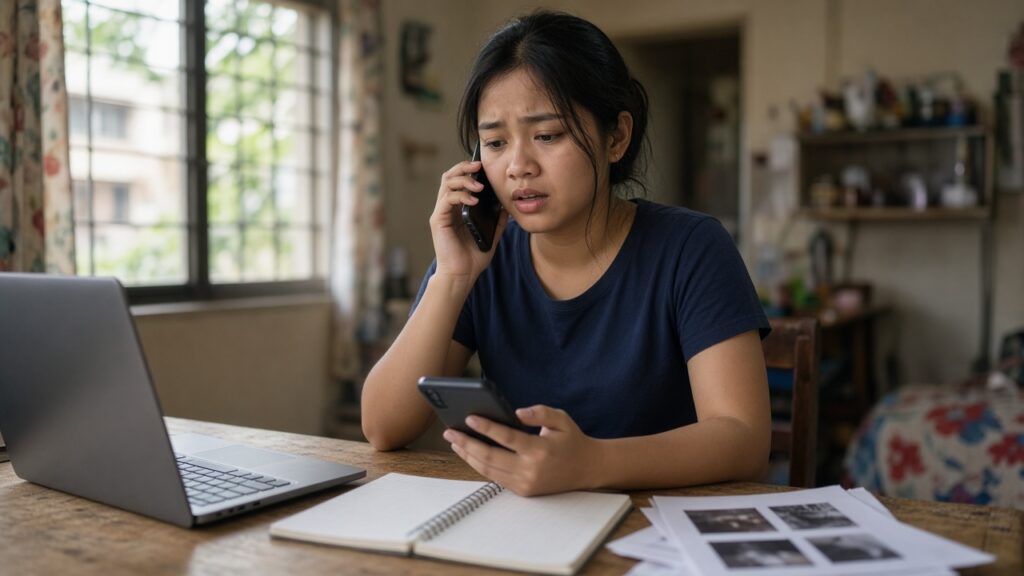
You sent ₱5,000 to a “seller” who suddenly went silent. Or you clicked a link that looked like your bank’s, typed your OTP, and watched your balance drop. It happens to careful people too, and the shame that follows often makes victims wait. Waiting is the one thing you should not do.
This guide walks you through what to do in the first hour, where to report an online scam in the Philippines, what evidence to keep, and what the law says about getting your money back. Recovery is never guaranteed, but acting fast gives you the best chance.
Step 1: Call your bank or e-wallet right away
Before anything else, contact the bank or e-wallet you used (GCash, Maya, your bank, and so on). Use only the hotline or help center inside its official app or website, or the number printed on the back of your card. Never use a “customer service” number you found in a Facebook comment or a random search result, because scammers post fake ones.
When you reach them:
- Say clearly that the transaction is a scam or was unauthorized, and give the date, time, amount and reference number.
- Ask them to block your card or lock your account if your details were stolen.
- Ask whether the funds on the receiving account can be held, and write down the case or ticket number they give you.
- Ask what documents they need from you and the deadline for sending them.
Why speed matters: under the Anti-Financial Account Scamming Act (Republic Act No. 12010), signed on July 20, 2024, banks, e-wallets and other BSP-supervised institutions can temporarily hold funds in a disputed transaction for a period set by the Bangko Sentral ng Pilipinas, which cannot exceed 30 calendar days unless a court extends it (Section 7). A hold only helps if the money has not yet been withdrawn or moved, so every hour counts.
Step 2: Secure your accounts
If you shared a password, PIN or one-time password (OTP), assume someone else can get into your account.
- Change your passwords, starting with your email, then your banking and e-wallet apps.
- Turn on two-factor or multi-factor authentication wherever it is offered.
- Log out of other devices if the app allows it.
- If your SIM or phone was taken over, call your telco to block or replace the SIM, since many OTPs are sent by SMS.
- Warn family and friends if your Facebook or Messenger was hacked, because scammers often use stolen accounts to ask your contacts for “pautang”.
Step 3: Save the evidence before you block anyone
It is tempting to delete the chat and block the scammer out of anger or embarrassment. Save everything first. Investigators and your bank will need it.
- Screenshots of the conversation, showing the scammer’s name, profile link, number or account, plus the dates and times.
- Links (URLs) of the fake page, website, post or ad. Copy them, but do not click them again.
- Your transaction receipts and reference numbers, and the receiving account name and number.
- Your bank or e-wallet statement showing the transfer.
- Phone numbers that called or texted you, and any emails with their full sender address.
Then write a short timeline in your own words: when they first contacted you, what they promised, what you sent and when. Do it while your memory is fresh. If you file a criminal complaint later, you may be asked to sign a sworn statement, and a ready timeline makes that much easier.
Step 4: Report to the CICC hotline 1326
The government’s main anti-scam hotline is 1326, run by the Inter-Agency Response Center (I-ARC). According to Scam Watch Pilipinas, the I-ARC is composed of the Department of Information and Communications Technology (DICT), the Cybercrime Investigation and Coordinating Center (CICC), the National Privacy Commission (NPC) and the National Telecommunications Commission (NTC), with the PNP and NBI as its enforcement arm in the field.
You can call 1326 for online scams, phishing, hacked social media accounts and similar cases. If you cannot get through, Scam Watch Pilipinas lists these I-ARC mobile numbers as alternatives:
- 0947-714-7105 (Smart)
- 0966-976-5971 (Globe)
- 0991-481-4225 (DITO)
You can also send a message to the official CICC Facebook page, which Scam Watch Pilipinas recommends for reporting suspected scam numbers, pages and websites even if you did not lose money. The CICC also has an online reporting page at cicc.gov.ph/report.
Keep in mind that a hotline report is not the same as a criminal case. It helps the government track, block and refer scams, but if you want the scammer investigated and charged, you will usually need to file a formal complaint.
Step 5: File a complaint with the PNP or NBI
For a criminal investigation, go to either of these:
- PNP Anti-Cybercrime Group (ACG), at its main office in Camp Crame or a regional anti-cybercrime unit.
- NBI Cybercrime Division, at NBI headquarters or a regional office.
Bring a valid ID, your printed screenshots, receipts, statements and your written timeline. Call ahead or check their official pages for current requirements and office hours, since procedures can change. Before you go, double-check that any website or email you are dealing with ends in .gov.ph; fake “government” pages exist too.
Step 6: Report the account on the platform
Report the scammer’s profile, page, listing or ad on Facebook, Marketplace, TikTok, Shopee, Lazada or wherever it happened, after you have saved your evidence. If you paid through a marketplace’s own checkout, also open a refund or dispute inside the app; these usually have strict deadlines. An abuse report and a refund request are separate things, so do both if they apply.
What if your bank or e-wallet doesn’t help?
Follow up in writing using your case number, and ask for the status of any hold and when you can expect a decision. If you are still not satisfied with how a BSP-supervised bank or e-wallet handled your complaint, you can escalate to the Bangko Sentral ng Pilipinas. We explain how in our guide on how to file a complaint with BSP against a bank or e-wallet.
RA 12010 also matters here. Section 6 says institutions must protect accounts with adequate safeguards such as multi-factor authentication and fraud management systems, and that they are liable to pay back (restitution) account owners if they fail to do so or fail to exercise the highest degree of diligence. The law adds that conviction of the scammer is not a prerequisite for restitution. However, the same section says institutions found compliant by the BSP are not liable, so not every loss will be refunded. Whether your case qualifies depends on the facts.
Watch out for “recovery” scams
After you post about being scammed, you may get messages from “hackers”, “lawyers” or “agents” who promise to recover your money for a fee. This is very often a second scam aimed at people who were just victimized. Legitimate agencies like the CICC, PNP and NBI do not charge you a fee to recover funds, and no one can honestly guarantee recovery.
Never lend or sell your account
Scammers need bank and e-wallet accounts to move stolen money, so some offer cash to “rent” or buy yours, or ask you to receive and forward money for a small commission. Under RA 12010, using, lending, selling or renting out a financial account to move scam proceeds is money muling. Section 16 punishes it with 6 to 8 years in prison, a fine of ₱100,000 to ₱500,000, or both. Buying or selling a financial account is a separate offense too. No “easy extra income” is worth that.
A quick checklist
- Call your bank or e-wallet through its official channel and get a case number.
- Change passwords and turn on two-factor authentication.
- Save screenshots, links, receipts and a written timeline.
- Call 1326 or message the official CICC page.
- File a complaint with the PNP-ACG or NBI if you want a criminal case.
- Report the account on the platform and open a refund dispute if available.
- Ignore anyone who asks for a fee to “recover” your money.
Being scammed is not a sign that you are foolish. Scammers are organized and they study how to rush and pressure people. What helps most is acting quickly, keeping your evidence, and reporting through official channels. For red flags to watch out for next time, read our guide on how to spot money scams in the Philippines, and before borrowing from any app, see how to check if an online lending app is legit.
This article is general information only and not financial advice. Rates, rules and fees change, so please verify with the provider or the official agency before deciding.