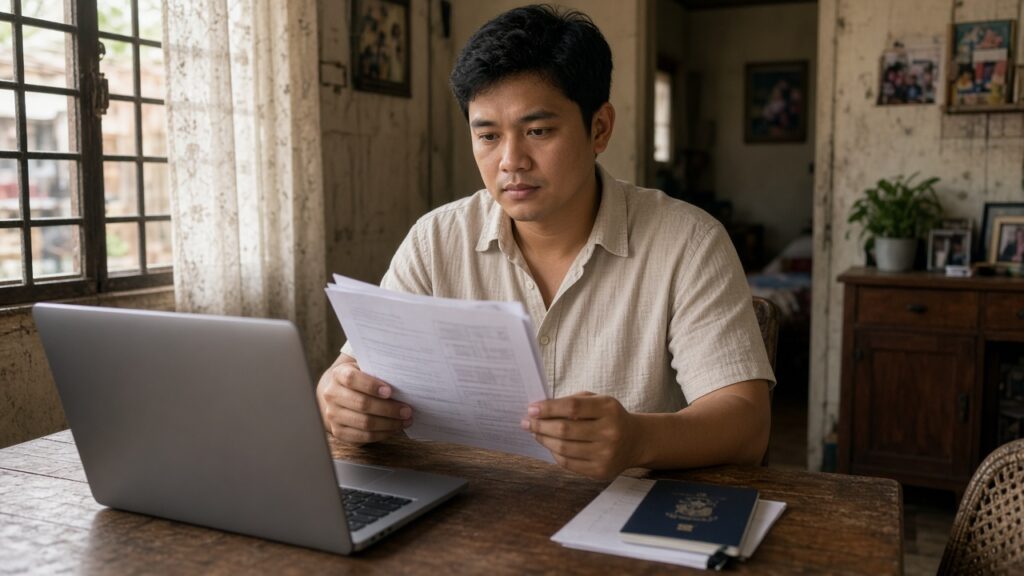
Si Marco, 29, saw a post in a Facebook group: “Hiring warehouse workers for Europe, ₱90,000 a month, fast deployment, no experience needed. Reservation fee ₱25,000 via GCash lang.” The recruiter replied within minutes, sent a “job offer” PDF, and kept saying slots were almost gone. Marco almost borrowed the money from his tita.
Working abroad can be a real way to earn more for your family. But the same dream is exactly what illegal recruiters sell. The good news: you can check most offers yourself, for free, before you pay a single peso. This guide shows you how to verify an overseas job offer with the Department of Migrant Workers (DMW), what fees are actually allowed, and the red flags that should make you stop.
Why you should verify every overseas job offer
The DMW, created under Republic Act No. 11641, took over the functions of the former POEA and is the agency that licenses Philippine recruitment and manning agencies. Only licensed agencies (or the government itself) may recruit Filipinos for jobs abroad.
Recruitment by anyone without a license or authority is illegal recruitment. Under Republic Act No. 10022, which amended the Migrant Workers Act (RA 8042), the penalty is imprisonment of 12 years and one day up to 20 years plus a fine of ₱1 million to ₱2 million. If it is done by a syndicate (three or more people conspiring) or in large scale (against three or more victims), it is treated as economic sabotage, punishable by life imprisonment and a fine of ₱2 million to ₱5 million.
Families lose savings and take on utang because of these scams. Verification takes a few minutes and costs nothing.
Step 1: Get the complete details from the recruiter
Before anything else, ask the person contacting you for these in writing:
- The full registered name of the Philippine recruitment agency (not just a nickname or Facebook page name)
- The agency’s DMW license number and office address
- The full name of the person handling your application and their position in the agency
- The foreign employer’s name, the exact position, and the country and jobsite
- The basic monthly salary as stated in the contract
A legitimate agency will give this without drama. If the “recruiter” refuses, gets angry, or says “trust me na lang,” that is already your answer.
Step 2: Check the agency’s license on the DMW website
Go directly to the DMW’s Licensed Recruitment Agencies page. Type the agency’s name yourself. Do not click a link the recruiter sent you, because fake look-alike sites exist.
When you find the agency, read the status beside its name. The directory includes agencies whose licenses are valid as well as those that are suspended, cancelled, delisted, or otherwise no longer active. Being listed is not enough. Look for a valid license and check that it has not expired.
Tips for searching:
- Try different spellings, with and without “Inc.”, “Corp.” or punctuation, if nothing comes up.
- Compare the address in the DMW record with the address the recruiter gave you.
- For seafarer jobs, check the manning agency, since ship-based work goes through licensed manning agencies.
Step 3: Match the offer to an approved job order
This is the step most applicants skip. A licensed agency can only recruit for positions covered by job orders approved by the DMW. Use the DMW’s Approved Job Orders search and look for a record that matches the same agency, same foreign employer, same position, and same country.
A job order for “factory worker in Taiwan” under Agency A does not make Agency B’s “factory worker in Poland” offer legitimate. And if you can’t find a match, don’t jump to conclusions either way. Ask the agency which approved job order covers your position, then confirm with the DMW before you submit documents or pay.
Step 4: Verify the person, not just the agency
Scammers often borrow the name and license number of a real, licensed agency. They copy its logo, repost its old ads, and pretend to be its “coordinator.”
To protect yourself:
- Call the agency using the contact details in the DMW record, not the number in the chat.
- Ask if they posted the ad, if the person messaging you really works for them, and where you should submit your documents.
- Go to the agency’s registered office for interviews and payments. Be extra careful with “interviews” in hotels, restaurants, private homes, or venues announced only in a group chat.
Step 5: Know which fees are allowed
This is where a lot of money is lost, so read slowly.
Under the 2023 DMW Rules and Regulations Governing the Recruitment and Employment of Landbased OFWs (Department Circular No. 01, series of 2023), a licensed agency may charge a land-based worker a placement fee of up to one month’s basic salary as stated in the DMW-approved employment contract. The rules also say:
- The fee may only be collected after you have signed the DMW-approved employment contract.
- The agency must give you an official receipt showing the date, purpose and exact amount paid.
- Domestic workers cannot be charged a placement fee.
- No placement fee may be charged for destinations whose law, policy or practice does not allow it. For example, the DMW issued Advisory No. 24-A, series of 2024 clarifying the no-placement-fee policy for workers deployed to Qatar.
So if the contract says a basic salary equal to ₱40,000 a month, the most a licensed agency may charge as placement fee (where one is allowed at all) is ₱40,000, and only after you sign. A ₱25,000 “reservation fee” before any contract exists, like the one offered to Marco, does not fit these rules.
Watch out for fees with creative names: “slot fee,” “processing fee,” “visa assistance,” “training deposit,” “medical reservation.” Calling it something else doesn’t make it allowed. If you are unsure whether a charge is legal, ask the DMW before paying.
Red flags of illegal recruitment
One red flag doesn’t automatically mean a scam, but each one is a reason to stop and verify:
- Payment to a personal GCash, Maya, or bank account instead of the agency, with no official receipt
- Payment before you have a contract to read and sign
- “Guaranteed” or super-fast deployment, like “alis ka in two weeks”
- Salary that is too good to be true for a job needing no experience or skills
- Travel on a tourist or visit visa with a promise that it will be “converted” to a work visa once you arrive
- Instructions to lie to immigration officers about why you are traveling
- Everything happens only in chat: no office, no landline, no verifiable person
- Pressure tactics: “Last slot na lang,” “Today lang ang promo,” “Huwag mo nang sabihin sa iba”
What to do if you already paid
Kung nabiktima na, don’t let hiya stop you from acting quickly:
- Stop paying. Scammers often ask for “one last fee” to release a visa or a refund. Don’t.
- Save everything. Screenshots of chats with dates and names, the recruiter’s profile link, GCash or bank transaction records, receipts, and any documents they sent. Don’t delete the conversation.
- Contact your bank or e-wallet right away to report the transaction and ask whether anything can be held or traced.
- Report to the DMW. You can go to the DMW central office or the nearest DMW regional office, or call the DMW hotline 1348. Use the contact directory on the official DMW website for current numbers and emails.
- Report to law enforcement such as the PNP or NBI, especially if there are threats, many victims, or an upcoming departure.
You can report even if you only saw a suspicious post and haven’t paid anything. Early reports help protect the next applicant.
A quick checklist before you pay anything
- ☐ Agency has a valid license on the DMW website
- ☐ There is an approved job order matching the employer, position and country
- ☐ The person talking to you is confirmed by the agency, using contact details from DMW records
- ☐ You have read and signed a DMW-approved contract
- ☐ Any placement fee is no more than one month’s basic salary, and none at all if you’re a domestic worker or going to a no-fee country
- ☐ You pay the agency itself and get an official receipt
Bottom line
Working abroad can genuinely improve your family’s finances, but only if the job is real. Before you borrow money, resign from your current job, or hand over your passport, spend a few minutes on the DMW website checking the agency, the job order and the person. A real opportunity will still be there after you verify. A scam usually disappears the moment you start asking questions.
This article is general information only and not financial advice. Rates, rules and fees change, so please verify with the provider or the official agency before deciding.