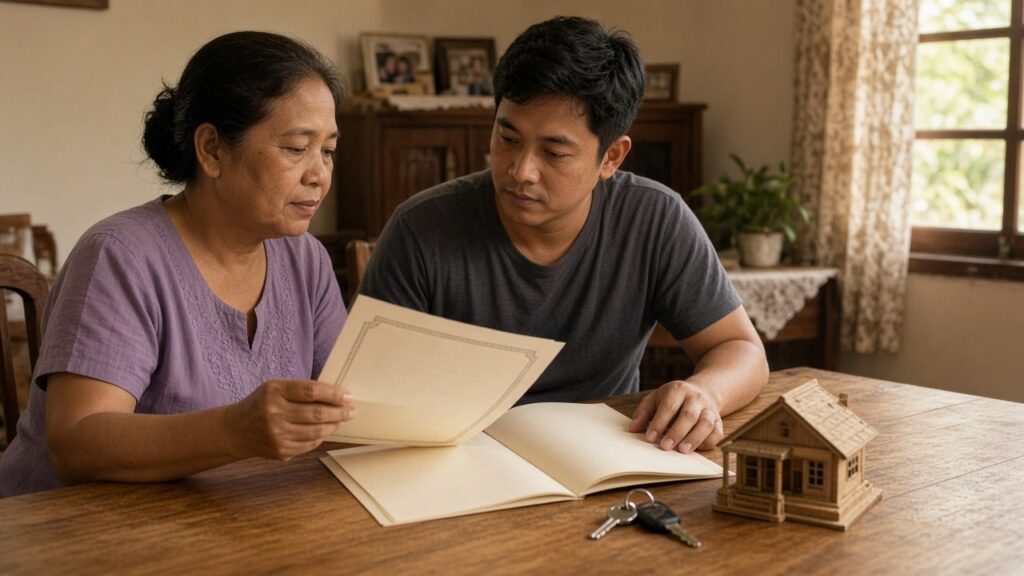
A lot of Filipino parents quietly plan to “transfer the title later” or put a child’s name on the land through a deed of sale with a low price. Both moves can create a tax problem. If you give property away while you are alive, the BIR calls it a donation, and it is taxed at 6% of the value above ₱250,000 per year. This guide explains who pays, how the tax is computed, what paperwork the Registry of Deeds will ask for, and when waiting for inheritance might be the better choice.
What donor’s tax is
Donor’s tax is a tax on the transfer of property by gift, and it is paid by the person giving, not the person receiving. Since the Tax Reform for Acceleration and Inclusion (TRAIN) law took effect in 2018, the rate is a flat 6% of the total gifts made during the calendar year that exceed a ₱250,000 exemption. You can read the exact wording in Republic Act No. 10963, Sections 99 to 101.
TRAIN also removed the old difference between gifts to relatives and gifts to strangers. Your child, your parent, your cousin and a complete stranger are now taxed at the same 6% rate. On the receiving side, a gift is not treated as income, so the donee does not pay income tax on it.
The ₱250,000 exemption is per donor, per year
This is the part most families get wrong. The exemption belongs to the giver, not to the recipient and not to the property. A few consequences:
- If you give two children ₱150,000 each in the same year, that is ₱300,000 of total gifts, so ₱50,000 is already taxable even though no single child received more than ₱250,000.
- A married couple has two separate exemptions. If the property is truly conjugal or co-owned, each spouse can donate their own share and use their own ₱250,000, for a combined ₱500,000 tax-free amount per year.
- The exemption resets every January 1. Splitting a large donation across two calendar years can legitimately reduce the tax, as long as each transfer is real and properly documented.
Cash, land, a house, shares of stock, a car and even the cancellation of a debt you are owed can all be gifts. Selling something for far less than its fair market value can also be treated as a gift of the difference under Section 100 of the Tax Code.
How the 6% is computed
Take the fair market value of the gift, subtract the unused part of your ₱250,000 exemption for the year, and multiply the remainder by 6%. Here is a simple example using a house and lot with a BIR zonal value of ₱2,500,000, donated by one parent:
| Item | Amount |
|---|---|
| Fair market value of the property | ₱2,500,000 |
| Less: annual exempt gift | ₱250,000 |
| Taxable net gift | ₱2,250,000 |
| Donor’s tax at 6% | ₱135,000 |
If the property is co-owned by both parents and each one donates a ₱1,250,000 share, each parent pays 6% of ₱1,000,000, or ₱60,000, for a total of ₱120,000. The ₱15,000 difference is real, but only if the ownership is genuine and reflected in the title. A “deed of donation” that pretends a solo-owned property is conjugal is not a tax plan.
When and where to file
File BIR Form 1801 (Donor’s Tax Return) within 30 days after the donation, with the Revenue District Office that covers the donor’s residence or, for real property, the place where the property is located. Pay the tax at the same time. The BIR accepts returns through eBIRForms and payments through its authorized channels; check the BIR website for the current links because the portal changes from time to time.
For real property, the order matters. The BIR issues a Certificate Authorizing Registration (CAR) only after the donor’s tax and documentary stamp tax are paid. The Registry of Deeds will not transfer the title without that CAR. Expect the process to take a few weeks even when everything is in order.
Which gifts are exempt
Section 101 of the Tax Code exempts only a narrow set of donations, mainly:
- Gifts to the National Government, its agencies and instrumentalities, or any political subdivision;
- Gifts to educational, charitable, religious, cultural or social welfare corporations and accredited non-government organizations, provided they are nonstock, nonprofit and use no more than 30% of the donation for administration.
There is no exemption for giving land to your children, your parents or your siblings. “Advance inheritance” is still a donation today, and it is taxed today.
Costs beyond the 6%
Donor’s tax is not the only expense. When real property changes hands, budget for:
- Documentary stamp tax on the deed, computed by the BIR from the property’s value;
- Transfer tax paid to the city or municipal government, generally 0.5% of the value;
- Registration fees at the Registry of Deeds;
- Notarial fees, certified true copies, tax clearance and, if needed, a survey;
- Real property tax up to the date of transfer, which the local assessor will check before recording the new owner. Our guide on amilyar explains how that is computed.
Capital gains tax does not apply to a donation. It applies to a sale or exchange, which is one reason some families mistakenly use a deed of sale to move property to a child. If the price is below the zonal value or the real fair market value, the BIR can question the transaction or treat the difference as a taxable gift.
Documents you will need
- Owner’s duplicate copy of the TCT or CCT, and the tax declaration;
- Latest real property tax receipt and clearance;
- BIR zonal valuation for the property, or an appraisal if the value is higher;
- A notarized deed of donation, signed by the donor and accepted by the donee;
- Written consent of the spouse if the property is conjugal;
- Valid IDs and TIN of both donor and donee;
- BIR Form 1801 and proof of payment;
- CAR from the BIR, then the transfer documents for the Registry of Deeds and the assessor.
If you do not have a TIN yet, the BIR’s online registration system can issue one; our TIN guide walks through it.
Donate now or leave it as inheritance?
Both routes are taxed at 6%, but the deductions are different. Donor’s tax gives only the ₱250,000 annual exemption. Estate tax, paid after death, allows a ₱5,000,000 standard deduction and a family home deduction of up to ₱10,000,000, plus deductions for debts and expenses. For a modest family home, inheritance can therefore be tax-free, while a donation of the same property may not be.
Donation still has advantages: the transfer happens while the parent is alive, the children avoid a lengthy estate settlement, and disputes are settled early. But it is not automatically cheaper. Compute both scenarios with a tax professional before signing anything, and read our guide on estate tax so you are comparing the real numbers.
Common mistakes to avoid
- Using a low-priced deed of sale. The BIR can assess the difference as a gift, and a false price can expose you to penalties.
- Forgetting gifts made earlier in the year. The ₱250,000 is an annual total, so small cash gifts count too.
- Ignoring the spouse’s share. A conjugal property cannot be donated by one spouse alone, and donations between spouses during the marriage are void except for moderate gifts on family occasions.
- Paying the tax but skipping the CAR. Without it, the Registry of Deeds cannot register the transfer.
- Assuming a verbal promise is enough. A donation of real property must be in a public document and accepted in writing by the donee.
Donor’s tax is manageable when it is planned. The expensive version is the one discovered years later, when a title is still in a dead parent’s name and every buyer, bank and heir has a question. Keep the deed, the return, the receipts and the CAR together, and give copies to the donee. If you are also writing a will for the rest of your estate, our holographic will guide explains the requirements.
This article is general information only and not financial advice. Rates, rules and fees change, so please verify with the provider or the official agency before deciding.