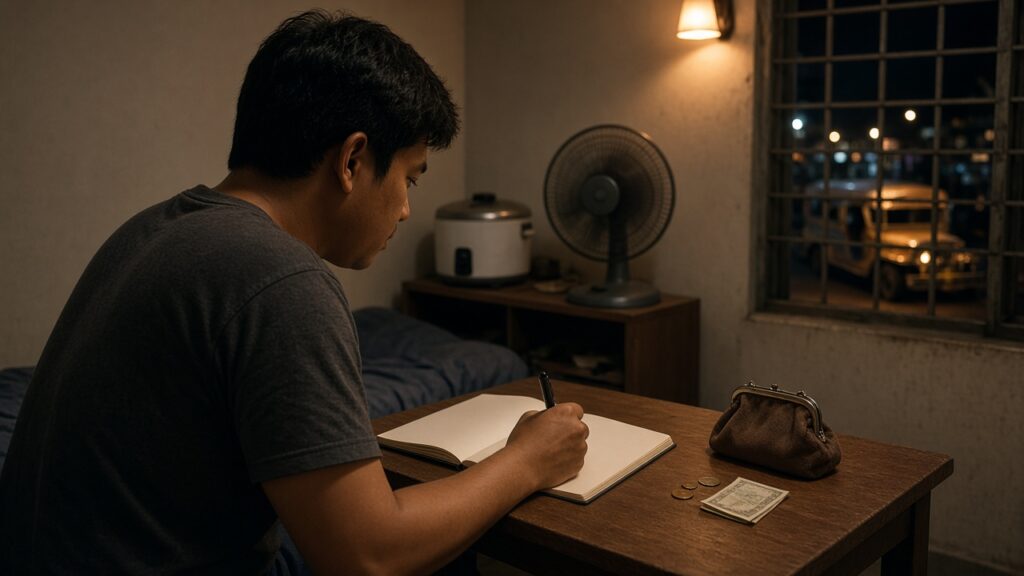
₱755 a day sounds workable until you multiply it by 26 days. That is ₱19,630 a month gross, and after the mandatory deductions you are budgeting around ₱17,964 for rent, food, transport and everything else in Metro Manila.
This is not a lecture about “discipline.” At this income level, a budget only works when the big three — housing, food and transport — are set up correctly from the start. Below is the actual math for a minimum wage earner in the National Capital Region in late 2026, using official rates, plus a working monthly plan and the few changes that genuinely move the numbers.
What ₱755 a day really means per month
The NCR daily minimum wage for non-agriculture workers is ₱755, effective 26 September 2026 under Wage Order No. NCR-28, according to the National Wages and Productivity Commission. Agriculture, retail and service establishments with 15 workers or fewer, and manufacturing with fewer than 10 workers, are at ₱718.
Minimum wage is a daily rate, so your monthly pay depends on days actually worked. The common estimate is 26 paid days:
| Daily rate | ₱755.00 |
| Paid days per month (estimate) | 26 |
| Monthly gross pay | ₱19,630.00 |
Two things follow from that. First, absences and unpaid holidays cut this directly — there is no “no work, no pay” cushion. Second, your 13th month pay is roughly one month’s basic salary, so around ₱19,630, paid in December. It is exempt from income tax up to ₱90,000, which is worth planning for rather than spending in one weekend.
The deductions you never see
Three mandatory contributions come out before your take-home pay, and all three are based on your salary, not on what is left over:
| Contribution | Basis | Your share |
|---|---|---|
| SSS | 5% of a ₱19,500 Monthly Salary Credit | ₱975.00 |
| PhilHealth | 2.5% of ₱19,630 (half of the 5% premium) | ₱490.75 |
| Pag-IBIG | 2% of the ₱10,000 maximum fund salary | ₱200.00 |
| Total deductions | ₱1,665.75 | |
| Take-home pay | ₱17,964.25 |
The rates are the current ones: 15% total for SSS with 5% shouldered by the employee, per the SSS contributions page; the 5% PhilHealth premium with a ₱10,000 floor and ₱100,000 ceiling under the UHC Act; and the ₱10,000 Pag-IBIG fund salary cap. Details and worked examples are in our guides on SSS contributions, PhilHealth contributions and Pag-IBIG contributions.
Income tax? Zero. At ₱19,630 a month your annual taxable income is about ₱235,560, below the ₱250,000 exemption for individuals. If your payslip shows withholding tax on basic pay alone, ask HR to check the computation.
A budget that adds up to ₱17,964
This assumes a single person renting a bedspace or sharing a room in Metro Manila, commuting daily, and supporting family a little. Every line is an assumption you can adjust — but the total has to fit the take-home pay, not the gross.
| Item | Monthly | Notes |
|---|---|---|
| Bedspace or room share | ₱4,500 | ₱3,500–₱5,500 is typical near business districts |
| Electricity and water share | ₱800 | Higher if you use aircon or a fridge |
| Food | ₱6,500 | About ₱250 a day, carinderia and home cooking |
| Transport | ₱2,200 | About ₱100 a day for 22 workdays |
| Load and data | ₱300 | Promo rather than open data |
| Laundry and personal care | ₱600 | Laundromat plus soap, shampoo, toothpaste |
| Support to family | ₱1,500 | Adjust to what you promised, not to what is asked |
| Savings | ₱1,000 | Treat as a bill, not as leftovers |
| Buffer | ₱560 | Medicine, fare increases, birthdays |
| Total | ₱17,960 | Leaves about ₱4 unallocated |
Notice what is missing: no new phone, no subscription, no Grab rides, no shopping, no utang payments. That is not a moral judgment — it is arithmetic. There is no room in this budget for a ₱2,000 monthly installment, which is exactly why buy now, pay later offers are dangerous at this income.
Rent decides everything else
At ₱4,500, housing already takes 25% of your take-home pay. Push that to a ₱7,000 solo room and you have removed ₱2,500 from food, transport and savings — the entire savings line plus the buffer, twice over. In Metro Manila, the housing decision is the budget decision.
What actually works at this level: a bedspace within walking distance or one ride of work, sharing a room with a trusted coworker, or staying with relatives for the first year while you build an emergency fund. Commuting two hours each way to save ₱1,000 in rent usually costs more in fare, meals and health.
Five moves that genuinely change the numbers
1. Cook once, bring baon
A ₱90 carinderia lunch five days a week is ₱1,800 a month. Cooking a big batch on Sunday and packing lunch can cut that by half. Our baon meal prep guide has a workday plan built on palengke prices.
2. Fix the transport routine
One jeepney ride each way is roughly ₱30–₱40 daily. Add an MRT or LRT leg and you are near ₱100. A stored-value rail card, walking one stop, and avoiding peak-hour ride-hailing when it surges can save ₱300–₱500 a month without changing your life.
3. Buy at the palengke, not the grocery
Rice, eggs, vegetables and chicken are consistently cheaper by the kilo at a public market. Buying rice in a 10-kilo sack instead of 2-kilo packs alone saves a few hundred pesos a month.
4. Stop paying interest to buy things you could delay
At this income, a 3% monthly add-on on a ₱6,000 phone is ₱180 a month for a year — small-looking, but it is 18% of your savings line. If you cannot pay cash next month, the honest answer is not yet.
5. Automate the ₱1,000
Move ₱500 every payday into a digital bank or GSave or Maya Savings, and the other ₱500 into Pag-IBIG MP2. Money that never sits in your wallet does not get spent. Once you have one month of expenses saved, that is the start of your emergency fund, and it is what keeps a single hospital bill from turning into a loan.
If you live with your parents
The same ₱17,964 goes much further when rent is not in it. A realistic version: ₱2,000 shared household contribution, ₱6,000 food, ₱2,200 transport, ₱300 load, ₱600 laundry and personal care, ₱5,000 savings, and ₱1,864 buffer.
That ₱5,000 monthly savings is the single biggest financial advantage available at minimum wage. Six months of it is ₱30,000 — enough for a rental deposit, a TESDA short course, or a real emergency cushion. Spending it instead on a phone upgrade is the mistake most people make in their first working year.
What changes on 20 January 2027
Wage Order No. NCR-27 has a second tranche scheduled for 20 January 2027 that would raise the non-agriculture rate to ₱780 a day. But NWPC’s own page notes that NCR-27 is still subject to cases pending before the Pasig and Navotas regional trial courts, so treat it as a possibility, not a promise. If it takes effect, that is ₱25 more per day, about ₱650 a month gross. Do not sign a lease or a loan based on it.
The honest bottom line
₱755 a day is not a comfortable wage in Metro Manila. The budget above balances, but only because housing is shared and almost nothing discretionary is in it. If you are earning this rate and still short every month, the problem is usually structural — rent, dependents, or an installment — not your willpower.
Two practical next steps: track every peso for one month with a notebook or a free app so you can see where the leak is, and check whether you qualify for support you may be ignoring, from PhilHealth’s primary care packages to DOLE livelihood programs. And if your daily rate is below ₱755 in NCR, that is worth raising with HR or with the nearest DOLE office.
This article is general information only and not financial advice. Rates, rules and fees change, so please verify with the provider or the official agency before deciding.