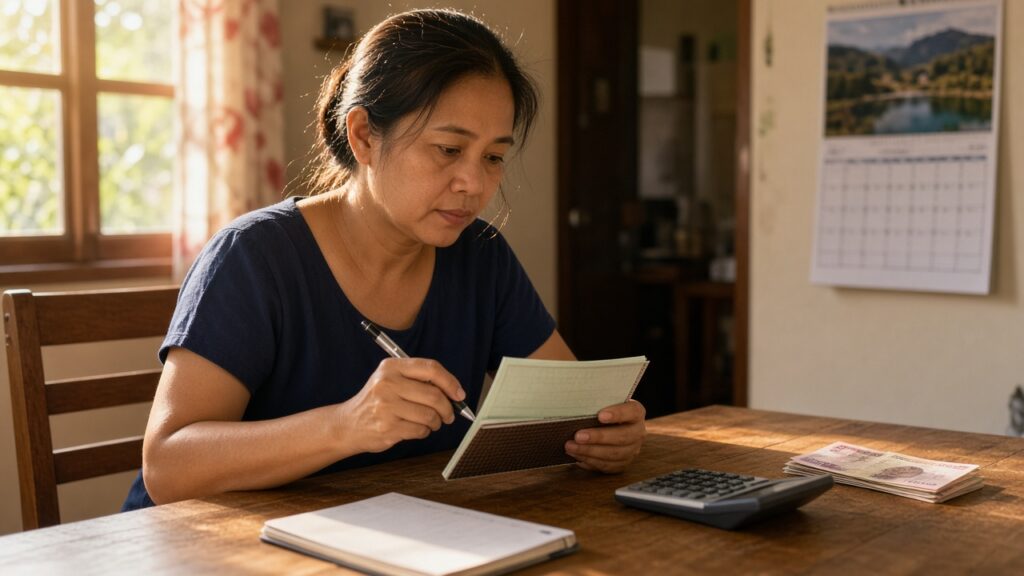
Postdated checks are everywhere in the Philippines. Landlords ask for 12 PDCs for a year’s rent, and some lenders and suppliers ask for them too. It looks simple: write the date, sign, and make sure you have the money by then.
The problem is when “make sure” does not happen. A delayed sahod, a client who pays late, or a medical emergency can leave your account short on the date written on the check. Then the check bounces, and you are no longer dealing with just an unpaid bill. You may be dealing with a criminal law: Batas Pambansa Blg. 22, the Bouncing Checks Law.
This guide explains what BP 22 says about a bounced check, what happens next, the penalties, and the habits that keep you out of trouble.
What BP 22 punishes
BP 22 was approved on April 3, 1979. Under Section 1 of the law, a person can be liable if he or she issues a check “to apply on account or for value,” knowing that there are not enough funds or credit in the bank to pay it in full, and the bank later dishonors it for insufficient funds. It also covers a check that would have bounced for lack of funds but was stopped by the drawer “without any valid reason.”
There is a second situation many people miss. Even if you had enough money when you wrote the check, you can still be liable if you fail to keep enough funds to cover it when it is presented within 90 days from the date on the check.
When a company check bounces, the law says the person who actually signed the check for the company is the one liable. So if you sign checks for your family business or employer, this applies to you too.
“Pero bawal ang makulong dahil sa utang, di ba?”
Yes, the 1987 Constitution, Article III, Section 20 says no person shall be imprisoned for debt. Simply being unable to pay a loan or credit card is not a crime.
But the Supreme Court has already ruled that BP 22 does not violate that rule. In Lozano v. Martinez (G.R. No. L-63419, December 18, 1986), the Court held that what BP 22 punishes is the act of issuing a worthless check and putting it into circulation, not the failure to pay the debt itself. That is why a bounced check is treated very differently from an ordinary unpaid utang.
The 5-banking-day window that matters most
This is the most useful part of the law for anyone whose check has bounced. Under Section 2 of BP 22, if a check is presented within 90 days from its date and is dishonored for insufficient funds, that is prima facie (presumed) evidence that the drawer knew the funds were insufficient. However, that presumption does not arise if the drawer pays the holder the amount due, or makes arrangements for full payment, within five banking days after receiving notice that the check was not paid.
In plain terms: if you receive a notice that your check bounced, you have five banking days to make it good. Paying within that window is the single most important step to protect yourself.
The Supreme Court has also stressed that this notice must be in writing and actually received. In Domagsang v. Court of Appeals (G.R. No. 139292, December 5, 2000), the accused was acquitted of the BP 22 charges because there was no proof of a written notice of dishonor. But she was still ordered to pay the ₱563,800 face value of the checks, plus legal interest. Getting off on a technicality does not erase the debt.
What are the penalties?
Section 1 of BP 22 provides for:
- imprisonment of not less than 30 days but not more than one year; or
- a fine of up to double the amount of the check, which in no case shall exceed ₱200,000; or
- both fine and imprisonment, at the court’s discretion.
Each bounced check can be a separate count. If you issued 12 rent PDCs and several bounce, that can mean several cases, not one.
“Fine lang naman ang BP 22”? Only partly true. In Administrative Circular No. 12-2000, the Supreme Court told judges to take note of its policy, from the Vaca and Rosa Lim cases, of imposing only a fine in appropriate cases. It then clarified in Administrative Circular No. 13-2001 that imprisonment was not removed. A fine alone is the preferred penalty when the circumstances show good faith or a clear mistake of fact, but the judge still decides. And if only a fine is imposed and the accused cannot pay it, subsidiary imprisonment under the Revised Penal Code can still apply.
BP 22 also states that prosecution under it is without prejudice to liability under the Revised Penal Code. In some cases, depending on the facts, a bounced check can also lead to an estafa complaint, which is a more serious offense.
You still owe the money
A BP 22 case is not a way to make the debt disappear. Under Rule 111, Section 1(b) of the Rules of Criminal Procedure, the criminal action for violation of BP 22 is deemed to include the corresponding civil action, and the complainant cannot reserve the civil case to be filed separately. The amount of the check is considered the actual damages claimed. So the same case can order you to pay the amount of the check, on top of any fine.
Practical habits before you issue a PDC
1. Only write checks you can fund with a buffer
Do not date a check on your exact payday. Pay and client payments can be delayed, and payees often deposit early. Give yourself a few days of cushion, or keep a small “check buffer” in the account on top of the amounts due.
2. Keep a PDC register
Write down every check you issue: number, date, payee and amount. Before each check date, compare the total due against your balance. This also makes your expense tracking more accurate, because PDCs are money that is already spoken for.
3. Treat PDC money as untouchable
If you have a separate account or sinking fund for rent or amortization, keep the checks drawn on that account and do not use it for daily spending.
4. Ask for alternatives
Many landlords and lenders now accept auto-debit arrangements, online transfers or e-wallet payments. If you are not confident about funding a whole set of PDCs months in advance, ask if another payment method is allowed. An online transfer that fails is a late payment problem. A bounced check can become a legal problem.
5. Do not use “stop payment” as an escape
BP 22 specifically covers checks that would have bounced for lack of funds had the drawer not ordered the bank to stop payment without a valid reason. A stop payment order is not a safe way to avoid a check you cannot fund.
6. Watch for stale checks on the receiving side
If you are the one receiving checks, deposit them promptly. Philippine banks commonly treat a check as stale about six months, or 180 days, from the date written on it, and may refuse it after that. Ask your bank for its exact rule.
If your check is about to bounce, or already did
- Before the date: Call the payee early. Explain honestly, deposit what you can, and ask to replace the check or move the date.
- After it bounces: Pay the full amount, or make arrangements for full payment, as soon as possible, and within five banking days of receiving the written notice. Get a receipt or written acknowledgment.
- Keep records: Save the notice, your proof of payment and any messages. If a case is filed, you will need them.
- If a complaint is filed: Do not ignore subpoenas. Consult a lawyer. If you cannot afford one, the Public Attorney’s Office provides free legal help to qualified clients, and many IBP chapters and law school legal aid clinics also help.
And if you are the payee holding a bounced check, the law gives you strong tools, but a written demand and a clear payment plan are often faster than a full case. For smaller unpaid amounts, also read our guide to small claims court.
Bottom line
A check is a promise backed by your signature and, under BP 22, by criminal law. Issue PDCs only when you can fund them with room to spare, track every one, and if something goes wrong, act fast: talk to the payee before the date and pay within five banking days of a written notice. Those habits protect both your wallet and your record.
This article is general information only and not financial advice. Rates, rules and fees change, so please verify with the provider or the official agency before deciding.