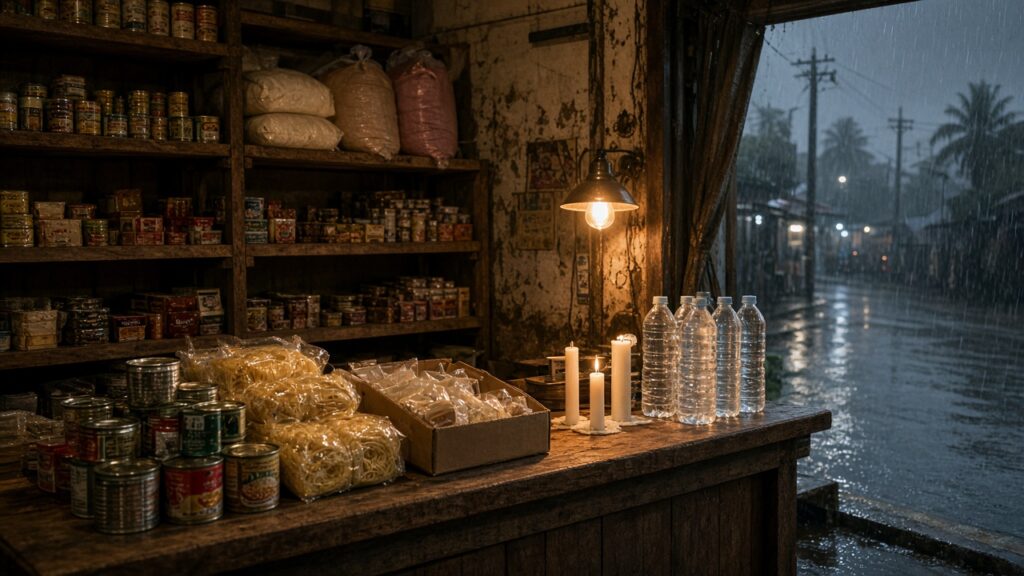
A typhoon passes, the brownout drags on, and you rush to the nearest tindahan for candles, bottled water and canned goods. Then you see it: the sardines that cost one price last week now cost noticeably more. “Mahal na raw kasi, ma’am, sir, bagyo.” Is that allowed?
Most of the time, no. The Philippines has a law that automatically freezes the prices of basic goods in areas hit by a calamity or emergency. It is called the Price Act, or Republic Act No. 7581, as amended by Republic Act No. 10623. Knowing how it works can save you real pesos exactly when your budget is tightest, and it helps you spot sellers who take advantage of a crisis.
What is an automatic price freeze?
Under Section 6 of the Price Act, unless the President declares otherwise, the prices of basic necessities in an area are automatically frozen at their “prevailing prices” whenever that area is:
- proclaimed or declared a disaster area or under a state of calamity;
- declared under an emergency;
- covered by a suspension of the privilege of the writ of habeas corpus;
- placed under martial law;
- declared in a state of rebellion; or
- under a declared state of war.
The word “automatic” matters. You do not need to wait for a separate DTI announcement for the freeze to apply once a calamity declaration covers your area. In practice, DTI, DA and other agencies usually announce and monitor these freezes, but the legal trigger is the declaration itself. The law also says “disaster” and “calamity” include those caused by natural or man-made events, so a typhoon, earthquake, flood or big fire can all qualify if a declaration is issued.
The “prevailing price” is defined in the law as the average price at which the item was sold in that area within a month before the calamity or emergency happened. So the reference point is the normal price before the crisis, not the “bagyo price.”
How long does the freeze last?
The freeze stays in effect for as long as the condition that caused it lasts, but not more than 60 days, unless the President lifts it earlier. RA 10623 added a shorter limit for basic necessities that are wholly imported and deregulated, such as household LPG and kerosene: their price freeze lasts no more than 15 days.
So if your barangay or city is placed under a state of calamity, a 60-day freeze clock generally starts for covered goods, and a 15-day clock for household LPG and kerosene.
Which goods are covered?
The automatic freeze applies to basic necessities. As amended by RA 10623, these include, among others:
- rice, corn, root crops and bread;
- fresh, dried or canned fish and other marine products;
- fresh pork, beef and poultry meat, and fresh eggs;
- bottled and container potable water;
- fresh and processed milk;
- fresh vegetables and fruits;
- locally manufactured instant noodles;
- coffee, sugar, cooking oil and salt;
- laundry soap and detergents;
- firewood, charcoal and candles;
- household LPG and kerosene; and
- drugs classified as essential by the Department of Health.
The law also lists prime commodities, such as flour, canned and processed meat, onions, garlic, vinegar, patis, soy sauce, toilet soap, school supplies, batteries, light bulbs, and construction materials like cement, GI sheets, hollow blocks, plywood and nails. Prime commodities are not automatically frozen, but the President may impose a mandated price ceiling on them (and on basic necessities) during a calamity, an emergency, widespread price manipulation, or when prices rise to unreasonable levels. That matters after strong typhoons, when demand for roofing and building materials spikes.
Different agencies watch different goods. Under the law, the Department of Agriculture covers farm and fishery products and fresh meat, the Department of Health covers drugs, the DENR covers wood and forest products, and the Department of Trade and Industry (DTI) covers all other basic necessities and prime commodities, such as canned goods, noodles, soap and batteries.
Overpricing tricks the law calls illegal
Beyond the freeze, Section 5 of the Price Act punishes three acts of “illegal price manipulation” at any time, calamity or not:
- Hoarding: stocking goods beyond normal inventory, or refusing to sell them to the public. There is prima facie evidence of hoarding when a seller has stocks 50% higher than usual and unreasonably refuses or fails to sell them.
- Profiteering: selling at a price grossly above the item’s true worth. Prima facie signs include goods with no price tag, short weight or measurement, adulterated or diluted products, or a price increase of more than 10% versus the previous month. (The 10% rule does not apply to agricultural crops, fresh fish and other seasonal products identified by the implementing agency, since their prices naturally swing.)
- Cartel: competing sellers agreeing to raise or manipulate prices together.
Penalties for violators
The Price Act carries serious penalties, which helps explain why many stores take freeze announcements seriously:
- Violating a price freeze or price ceiling: imprisonment of 1 to 10 years, or a fine of ₱5,000 to ₱1,000,000, or both, at the court’s discretion.
- Hoarding, profiteering or cartel activity: imprisonment of 5 to 15 years and a fine of ₱5,000 to ₱2,000,000.
- Administrative fines from implementing agencies of ₱1,000 to ₱1,000,000, after notice and hearing.
You can read these provisions in the Official Gazette copy of RA 7581.
Right now: DTI’s no-price-increase pledge until December 31, 2026
Separate from calamity freezes, the DTI announced on October 26, 2026 that there will be no price increase for DTI-monitored basic necessities and prime commodities until December 31, 2026. According to DTI, this covers the 190 products (SKUs) on its official Suggested Retail Price (SRP) bulletin, and supplies are sufficient, so there is no need for panic buying.
This is useful for Noche Buena and holiday grocery planning. If a covered item is priced above its SRP, you have grounds to ask, compare elsewhere, or report. See our guide on how to check the DTI SRP list and our Noche Buena budget plan.
What to do if you are overcharged
- Know the normal price. Take a quick photo of shelf prices of your regular items during ordinary weeks, or check the DTI SRP bulletin. Proof of the “before” price makes a complaint much stronger.
- Get proof of the “after” price. Ask for a receipt, or photograph the price tag and the store name. Note the date, time and address.
- Ask politely first. Some small stores honestly do not know about the freeze. Mentioning that your area is under a state of calamity sometimes fixes it on the spot.
- Report it. For DTI-covered goods, the DTI hotline is 1-384, and DTI lists [email protected] and [email protected] for price violations. For fresh meat, fish and vegetables, contact the Department of Agriculture or your local price monitoring office. You can also go to your city or municipal hall or barangay, since LGUs usually help monitor prices during calamities.
- Do not hoard either. Panic buying causes shortages that hurt neighbors with less cash. Buy what your household actually needs.
Practical money tips for calamity season
A price freeze protects you from abuse, but it does not put food on the table if your income stops. A few habits make a big difference:
- Keep a small “bagyo kit” stocked in advance: rice, canned fish, noodles, water, candles, batteries and essential medicines. Buying gradually at normal prices beats panic buying at crowded stores.
- Build an emergency fund, even ₱50 to ₱100 at a time. Our emergency fund guide shows how on a Philippine salary.
- Know your calamity loan options before you need them, such as the SSS Calamity Loan and the Pag-IBIG Calamity Loan, which open for members in declared calamity areas.
- Watch out for “relief” scams that ask for fees or your OTP in exchange for aid. Here is how to report an online scam.
The bottom line
When your area is declared under a state of calamity or emergency, prices of basic necessities are automatically frozen for up to 60 days (up to 15 days for household LPG and kerosene). Sellers who hike prices, hide stocks or skip price tags can face heavy fines and even jail time. Keep receipts and photos, compare against the DTI SRP list, and report abusive pricing. Hindi ka maarte for asking about prices during a calamity. You are protecting your budget, and your neighbors’ too.
This article is general information only and not financial advice. Rates, rules and fees change, so please verify with the provider or the official agency before deciding.